

Transformers and voltage converters both alter voltage, but they operate on separate principles, have different uses, and have various applications. The main distinctions are as follows:
The Way It Works
Transformer: An electrical device that changes power based on electromagnetic induction. It contains two windings-one primary and one secondary-in which current flowing in the primary winding makes a magnetic field that induces a voltage in the secondary winding. The change in voltage is based upon the turns ratio between the two windings.
AC Voltage Conversion: Transformers will work only with alternating current (AC).
Voltage Converter: A voltage converter is a more general device that can change voltage in more than one way. It can be used to step up or step down the voltage level, and it’s not just for AC voltage. Voltage converters may work with DC voltage or AC voltage based on the type.
Converting Between AC and DC Voltage: Voltage adapters can change between AC and DC voltage.
Applications
Transformer: Transformers are used most often in AC power systems and are the most important part of all systems that move and distribute electricity. A lot of different industries use them to change the voltage levels in power lines and other places.
Typical Applications: Power transmission, industrial tools, electrical grids.
Voltage Converter: Voltage converters are applied to small devices or special needs, such as home appliances, charging batteries, or electronics. They also allow for the flexibility of different voltage levels for consumer devices-for example, from 220V to 110V, or from AC to DC.
Typical Applications: Small electronics, home products, battery charging, and travel plug adapters.
Types and Varieties
Transformer: There exist basically two types of transformers, namely step-up transformers, which increase the voltage, and step-down transformers, which decrease the voltage, and these deal with AC voltage.
Voltage Converter: The voltage converters can be further grouped into:
AC-AC converters: It converts one type of AC voltage into another.
AC-DC converters: These converters change the AC power into DC voltage.
DC-DC converters: These are used to convert one level of DC voltage into another and find wide uses in battery-powered devices.
For instance, chargers are very common voltage switches that change AC to DC for the purpose of charging batteries.
Efficiency and Size
Transformer: Generally, transformers are more efficient but bigger and bulkier, especially for higher ratings of power. They can handle huge power loads, starting from a few kVA to several hundred MVA.
Voltage Converter: The voltage converters, especially switch-mode power supplies (SMPS), are normally smaller in size and lightweight. They are applied for small applications where space and weight are a matter of worry.
Current and Power
Transformer: Transformers are designed to work on higher power and, therefore, find their applications in industries and power transmission. It works on a power ranging from a few kVA to several hundred MVA.
Voltage Converter: Voltage converters are usually designed for lower power, although there are high-power converters for industrial use. Most voltage converters are for consumer goods, smaller appliances, or battery-powered devices.
Types of Voltage
Transformer: Generally designed to convert between different AC voltages.
Voltage Converter: Can convert both AC and DC voltages.
Key Differences in Summary
| Feature | Transformer | Voltage Converter |
| Working Principle | Based on electromagnetic induction | Uses electronic circuits (e.g., SMPS, rectifiers) |
| Applicable Voltage | Works with AC voltage only | Works with both AC and DC voltages |
| Applications | Power transmission, industrial equipment | Small electronics, battery charging, home appliances |
| Size and Efficiency | Larger, more efficient | Compact, can have high efficiency (depending on type) |
| Power Handling | Designed for high power applications | Primarily for low power applications |
Conclusion
In an AC voltage conversion, a transformer is used in large-scale power systems and electrical grids to step up or down the voltage for transmission or distribution purposes.
A voltage converter is versatile in handling both AC and DC voltages, thus finding applications in small and portable appliances like chargers, travel adaptors, and consumer electronic equipment.
In a nutshell, transformers are normally big-sized, high-power electrical grid devices, while voltage converters are smaller-size devices used for wider applications involving AC and DC voltage conversion.
Related Products
-
 DZW 220v to 380v single phase to 3 phase transformer
 -
 SBK 0.3Kva-5Kva Three-Phase Dry Type Isolation Transformer
 -
 QSG 10kva-100kva 3 Phase Dry-Type Autotransformer
 -
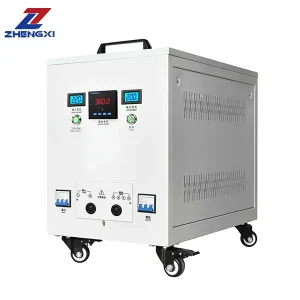 DZW 220v to 440v Single Phase To Three Phase Isolation Transformer
 -
 SG 10kva-100kva 3 Phase Indoor Low Voltage Dry Type Isolation Transformer
 -
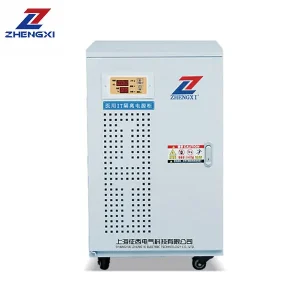 ES710 Medical Isolation Transformer – Single & Three-Phase Options



 EN
EN  DE
DE  ES
ES  FR
FR  RU
RU  PT
PT  IT
IT  JA
JA  DA
DA  PL
PL  NL
NL  TR
TR