


Industrial pump systems rarely operate under one perfect load condition all day. A water supply pump may need high flow during peak operation and much lower flow during quiet periods. A cooling water pump may need different flow rates in summer and winter. A booster pump may need to maintain pressure as demand rises and falls. A process pump may need more stable control than a simple on-off starter can provide.
This is where a VFD pump drive becomes useful.
A VFD, or variable frequency drive, controls the speed of an AC motor by changing the frequency and voltage supplied to the motor. Because motor speed is related to supply frequency, the drive can increase or decrease pump speed according to process demand. Instead of running the motor at full speed and using valves to restrict flow, a VFD allows the pump to work closer to the actual requirement.
For buyers, this is not only a technical point. It affects energy use, equipment stress, pressure stability, maintenance planning, and the accuracy of the quotation. A correctly selected VFD can make a pump system easier to control. A poorly selected VFD can create trips, overheating, unstable pressure, or unnecessary cost.
This guide explains how VFDs are used with industrial pumps, when they are useful, how to select them, and what information ZHENGXI Electric needs to recommend a suitable drive.
Why Pump Systems Use VFDs
Many pump systems are designed for the maximum expected demand. In real operation, however, the system may spend much of its time below maximum demand. If the pump is controlled only by direct-on-line starting, star-delta starting, or a simple contactor, the motor normally runs at full speed whenever it is operating.
Traditional flow control methods include throttling valves, bypass lines, dampers, and cycling pumps on and off. These methods can work, but they may waste energy, create pressure fluctuation, or increase mechanical wear. A VFD gives the system another control method: adjust motor speed.
For centrifugal pumps, this is especially important because pump output changes with speed. In general:
- Flow changes roughly in proportion to pump speed.
- Head changes roughly with the square of pump speed.
- Power demand changes roughly with the cube of pump speed.
These relationships are often called pump affinity laws. They are useful for understanding why speed reduction can reduce power demand in variable-flow centrifugal pump systems. Actual results depend on the complete system curve, static head, pipe friction, pump efficiency, and operating point, so the drive should be selected as part of the whole pump system.
Common Pump Applications for VFDs
VFDs are widely used in pump applications where flow, pressure, or process demand changes. The strongest cases are usually centrifugal pumps, fans, and other variable-torque loads.
| Application | Why a VFD is used | Typical buyer benefit |
|---|---|---|
| Water booster pumps | Maintains pressure as demand changes | More stable pressure and smoother operation |
| HVAC chilled water pumps | Adjusts water flow according to building load | Better system control and less unnecessary running |
| Cooling water pumps | Matches cooling flow to process demand | More stable process temperature |
| Irrigation pumps | Controls flow for different zones | Easier operation and less water hammer |
| Wastewater pumps | Responds to variable inflow | Reduced hard starts and better level control |
| Process pumps | Controls flow or pressure for production | Improved process consistency |
| Fire pump auxiliary systems | Controls non-emergency support pumps | Better pressure management where allowed by system design |
Not every pump needs a VFD. If the pump runs at one fixed duty point, only starts occasionally, and does not require speed control, a soft starter or standard starter may be more practical. The application should decide the product, not the other way around.
How a VFD Controls a Pump
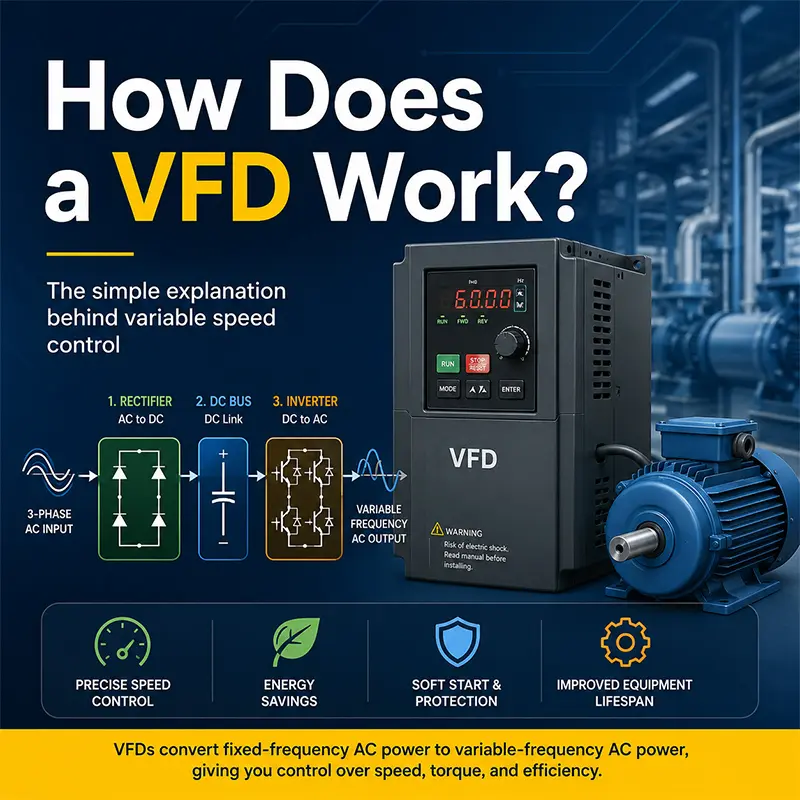
A VFD converts incoming AC power to DC internally and then uses power electronics to create a controlled AC output for the motor. By changing the output frequency, the VFD changes motor speed. By managing voltage with frequency, it helps the motor operate within a usable torque range.
In a pump system, the VFD may be controlled in several ways:
- Manual speed setting from the keypad.
- Analog signal from a pressure sensor, flow meter, or level transmitter.
- PID control inside the VFD to maintain pressure or flow.
- Digital signals from switches or relays.
- Communication with a PLC or building management system.
For example, in a booster pump system, a pressure sensor sends feedback to the VFD. If pressure drops below the setpoint, the drive increases motor speed. If pressure rises above the setpoint, the drive reduces speed. This creates smoother pressure control than repeated motor starting and stopping.
For a cooling water pump, a temperature controller or PLC may adjust the drive speed according to process temperature. For a tank filling system, a level sensor can control pump operation.
VFD Pump Drive Benefits
1. Speed Control for Variable Demand
The main benefit is speed control. Instead of forcing the pump to run at one speed, the VFD allows the system to match output to demand. This is important for pumps in buildings, industrial processes, water systems, and irrigation networks.
2. Reduced Starting Stress
A VFD can start the motor gradually by controlling acceleration time. This reduces mechanical shock on couplings, belts, shafts, pump impellers, and pipe systems. It can also reduce electrical stress compared with direct-on-line starting.
3. More Stable Pressure or Flow
When paired with sensors and proper parameters, a VFD can maintain pressure or flow more smoothly. This is useful for booster systems, cooling circuits, and process lines where unstable pressure can affect equipment or production quality.
4. Potential Energy Savings
In variable-demand centrifugal pump systems, reducing speed can reduce power demand. Energy savings are application-specific and should not be promised without reviewing duty cycle, operating hours, pump curve, and system curve. Still, this is one of the main reasons buyers evaluate VFD pump control.
5. Better System Automation
VFDs can be integrated with PLCs, pressure sensors, level switches, and building management systems. This makes them suitable for automated pump packages and industrial control panels.
When a VFD May Not Be the Best Choice
A VFD is not always required. A fixed-speed pump with stable demand may not justify the added cost and complexity. A simple starter or soft starter may be enough if the only concern is starting current or mechanical shock.
Positive displacement pumps require careful review. Reducing speed may affect lubrication, minimum flow, dosing accuracy, or process safety. Some pumps also need minimum cooling or minimum pressure to operate safely. The pump manufacturer and drive supplier should both be consulted.
Long motor cable runs, outdoor pump stations, humid environments, and poor power quality can also require additional design work. These issues do not prevent VFD use, but they affect selection and installation.
VFD Pump Drive Selection Guide
Confirm the Motor Nameplate
Select the VFD according to motor current and load characteristics.
- Power (kW / HP)
- Voltage & Current
- Frequency & Phase
- Motor Speed
- Insulation & Wiring
Identify the Pump Type
Different pumps require different torque and control methods.
- Centrifugal / Positive Displacement
- Fluid Type
- Minimum Flow
- Pressure or Level Control
- Continuous / Intermittent
Review Flow & Pressure
Hydraulic conditions determine proper VFD sizing.
- Flow Range
- Pressure
- Static Head
- Pipe Layout
- Application Details
Choose the Control Method
Control strategy determines wiring and accessories.
- Keypad
- PID Pressure Control
- Level Feedback
- PLC / Communication
Installation Environment
Environmental conditions affect enclosure and cooling selection.
- Indoor / Outdoor
- Temperature & Humidity
- Dust & Corrosion
- Cable Distance
- Ventilation
Power Quality & Protection
Additional protection improves long-term system reliability.
- Reactors
- Filters
- Voltage Stabilizers
- Surge Protection
- Harmonic Review
VFD Pump Drive Quotation Checklist
Send the following information to ZHENGXI Electric for a more accurate recommendation:
| Information | Why it matters |
|---|---|
| Motor power and rated current | Determines drive size and overload capacity |
| Motor voltage and phase | Confirms output compatibility |
| Input power supply | Confirms whether the drive input matches site power |
| Pump type | Affects torque and control requirements |
| Fluid or medium | Helps identify environmental and load concerns |
| Flow and pressure range | Supports correct control design |
| Control method | Determines sensor, PID, PLC, or communication needs |
| Cable distance | Affects cable, reactor, and filter decisions |
| Installation environment | Affects enclosure and cooling |
| Quantity and project market | Helps with quotation, documentation, and OEM support |
Common Mistakes to Avoid
The first mistake is selecting a VFD by motor HP only. Current rating, overload demand, voltage, load type, and duty cycle all matter.
The second mistake is ignoring the pump curve. A VFD can control speed, but it cannot correct a pump that is badly matched to the hydraulic system.
The third mistake is using an indoor drive in a wet, dusty, or hot pump room without suitable protection. Poor ventilation and moisture are common causes of failure.
The fourth mistake is assuming that lower speed is always safe. Some pumps need minimum speed for cooling, lubrication, or stable flow.
The fifth mistake is placing contactors or switches between the VFD and motor without proper control logic. Opening the VFD output during operation can create faults or damage.
Buying Tips for Importers and Contractors
If you are buying VFDs for resale or project use, request more than a simple price list. Ask for motor matching guidance, application notes, wiring recommendations, and available customization options.
For pump package builders, confirm whether the supplier can support OEM labeling, enclosure integration, input/output voltage options, keypad language requirements, and documentation for your target market.
For contractors, prepare site voltage, motor data, pump type, and control requirement before requesting a quotation. This makes the technical discussion faster and reduces the risk of incorrect selection.
FAQ
Can a VFD be used on any pump?
A VFD is commonly used with centrifugal pumps, but not every pump application is suitable. Pump type, torque demand, minimum speed, medium, and process requirements should be checked before selection.
Does a VFD always save energy on a pump?
No. Energy saving depends on the pump system. Variable-demand centrifugal pump systems often benefit most. If the pump always runs at one fixed duty point, the energy benefit may be limited.
What is PID control in a VFD pump system?
PID control allows the VFD to adjust motor speed automatically based on feedback from a pressure sensor, flow meter, or level transmitter. It is commonly used for constant pressure pump systems.
What size VFD do I need for a pump motor?
The VFD should be selected according to motor rated current, voltage, phase, load type, overload requirement, and installation conditions. Do not select by HP or kW alone.
Can a VFD reduce water hammer?
A VFD can reduce sudden starts and stops by controlling acceleration and deceleration, which may help reduce hydraulic shock. The full pipe system design still needs to be reviewed.
What information should I send for a VFD pump quotation?
Send motor nameplate data, pump type, input voltage, required pressure or flow, control method, cable distance, installation environment, and quantity.
Summary
A VFD pump drive is a practical solution when a pump system needs variable speed, pressure control, smoother starting, or automation. It is especially useful for centrifugal pump systems with changing demand, such as booster pumps, HVAC water pumps, cooling systems, irrigation, and process pumping.
The key to reliable operation is correct selection. Buyers should confirm motor current, voltage, pump type, flow and pressure requirements, control method, cable distance, and installation environment before choosing a drive.
Inquiry CTA
Need a VFD for a pump project? Send motor power, rated current, input voltage, pump type, pressure or flow requirement, cable distance, and installation environment to ZHENGXI Electric. Our team can help recommend a suitable VFD solution for your application.


 EN
 DE
 ES
 FR
 RU
 PT
 IT
 JA
 DA
 PL
 NL
 TR