

When researching AC motor control equipment, you may see the terms VFD (Variable Frequency Drive) and VSD (Variable Speed Drive). They are often used interchangeably in product catalogs, quotations, and technical discussions—but they do not always mean exactly the same thing.
Short Answer: Is a VFD the Same as a VSD?
In most industrial AC motor applications, yes. VFD and VSD commonly describe the same type of electronic AC motor drive.
Technically, however, a VFD is a type of VSD. A VFD controls AC motor speed by varying output frequency and voltage. The term VSD can be broader: depending on the industry, supplier, or technical standard, it may refer to electronic AC drives, DC drives, or other variable-speed systems.
For industrial buyers, the practical rule is simple: do not choose a drive based on the label alone. Confirm the motor current, input supply, overload duty, control mode, communication requirements, and operating environment.
Quick purchasing note: A supplier may describe an electronic AC drive as a VFD, VSD, AC drive, inverter drive, or frequency converter. For most modern AC motor applications, compare the actual datasheet—not just the product name.
VFD vs. VSD at a Glance
| Comparison | VFD | VSD |
|---|---|---|
| Full name | Variable Frequency Drive | Variable Speed Drive |
| Core meaning | An AC motor drive that changes output frequency | A broader term for equipment or systems that vary motor speed |
| Typical control method | Adjustable frequency and voltage; control mode varies by model | Depends on the drive technology and context |
| Typical motor use | AC induction and synchronous motors | AC or DC motors, depending on the system |
| Common industry usage | VFD, AC drive, inverter drive, frequency converter | Often used interchangeably with VFD for electronic AC drives |
| Practical purchasing focus | Current rating, overload duty, control and installation requirements | The same specification checks apply when referring to an electronic AC VSD |
What Is a VFD?
A Variable Frequency Drive is an electronic device used to control the speed of an AC motor by changing the frequency and voltage supplied to the motor.
In a fixed-speed motor system, motor speed is primarily related to the incoming power frequency and the number of motor poles. A VFD produces an adjustable output frequency, allowing the motor to operate at a speed appropriate for the process.
For example, a typical four-pole induction motor supplied at 50 Hz has a synchronous speed of 1,500 RPM. Its actual full-load speed is usually lower because of motor slip. When a compatible VFD reduces the output frequency, the motor speed decreases accordingly.
Depending on the selected drive and control mode, a VFD can provide:
- Adjustable motor speed for changing process demand
- Controlled acceleration and deceleration
- Lower starting current than direct-on-line starting in many applications
- Better process control for flow, pressure, machine speed, or material handling
- Improved speed regulation and torque performance with vector-control drive models
- Potential energy savings in suitable variable-torque applications
VFDs are commonly used with pumps, fans, blowers, conveyors, mixers, compressors, packaging machinery, and some spindle or auxiliary motor applications in industrial machines.

What Is a VSD?
A Variable Speed Drive is a general term for equipment that changes the operating speed of a motor or driven system.
In modern industrial automation, VSD most often refers to an electronic AC drive that adjusts motor speed by varying frequency and voltage—essentially the same product that many suppliers call a VFD. This is why the two terms frequently appear interchangeably in industrial purchasing.
In broader engineering use, the term VSD may also include other speed-control technologies, such as:
- Electronic AC drives: Control AC motor speed through adjustable frequency and voltage
- DC drives: Control DC motor speed by regulating armature voltage, current, or field conditions
- Mechanical variable-speed systems: Use mechanical transmission arrangements to change output speed
- Hydraulic variable-speed systems: Vary speed through hydraulic power transmission
The terminology can vary by manufacturer, market, and standard. When discussing a product with a supplier, ask whether the quoted VSD is an electronic AC drive and request its complete specification sheet.

The Main Difference Between VFD and VSD
The key distinction is scope.
- VFD is a more specific term. It refers to an electronic drive that varies output frequency to control AC motor speed.
- VSD is a broader term. In many industrial AC-drive applications it means the same type of electronic device, but it can also refer to other speed-control methods in broader technical contexts.
For example, one supplier may market an AC drive as a “VSD,” while another calls an equivalent product a “VFD.” Many common low-voltage PWM AC drives use a rectifier, DC link, and inverter architecture regardless of which term appears on the product label.
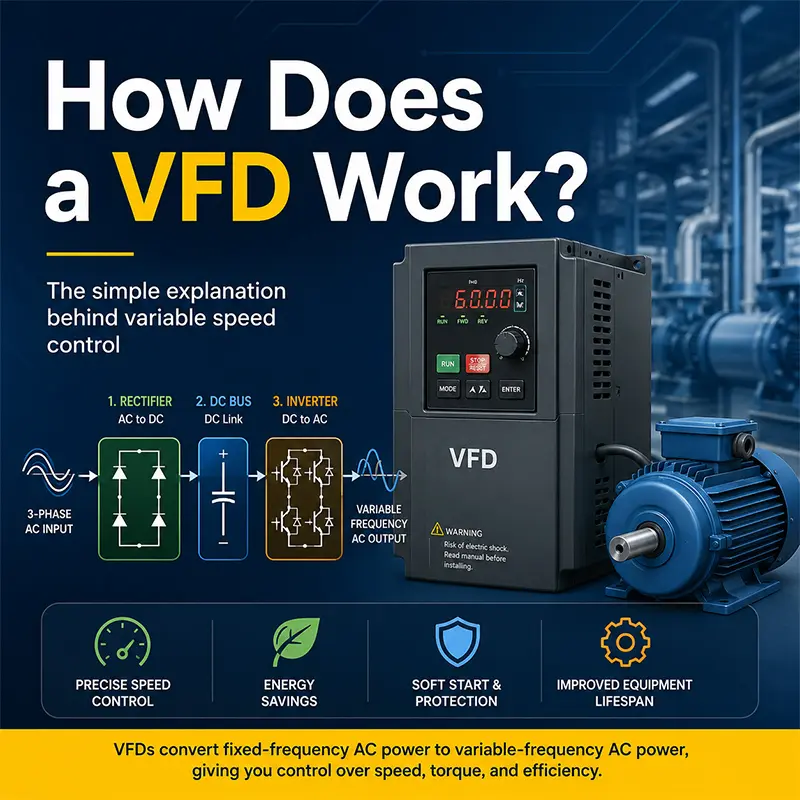
How Does a VFD Work?
Most common low-voltage AC VFDs use three main power-conversion stages.

1. Rectification
The input rectifier converts incoming AC power into DC power. The input supply may be single-phase or three-phase, depending on the VFD model and application.
2. DC Link
The DC link, often called the DC bus, uses capacitors and—in some designs—inductors or chokes to stabilize the DC voltage before it reaches the inverter stage.
3. Inversion
The inverter converts DC power back into AC power with an adjustable frequency and voltage. In many VFDs, switching devices such as IGBTs generate a pulse-width-modulated output waveform for the motor.
By adjusting the output frequency, the drive changes the motor’s synchronous speed:
Synchronous Speed (RPM) = 120 × Frequency (Hz) ÷ Number of Poles
For a four-pole motor:
| Output Frequency | Synchronous Speed |
|---|---|
| 20 Hz | 600 RPM |
| 30 Hz | 900 RPM |
| 40 Hz | 1,200 RPM |
| 50 Hz | 1,500 RPM |
| 60 Hz | 1,800 RPM |
Actual induction-motor speed is slightly below synchronous speed under load because of slip.
Where Are VFDs and Electronic VSDs Used?
Pumps and Water Systems
VFDs can adjust pump speed to match changing flow or pressure demand. In a properly designed pumping system, this can improve process control and reduce unnecessary full-speed operation.
Internal link: Explore VFDs for Pumps
HVAC and Ventilation
Fans and pumps in HVAC systems often operate under changing airflow or circulation requirements. An AC drive can adjust motor speed according to demand, control signals, or pressure feedback.
Internal link: Explore HVAC and Fan Drives
Conveyors and Material Handling
Conveyor systems may need controlled acceleration, deceleration, stable low-speed operation, or suitable overload capacity. Selection should account for whether the system starts under load and how frequently it accelerates.
Internal link: Explore VFDs for Conveyors
Compressors and Industrial Machinery
VFDs can be used in variable-speed compressor and industrial-machine applications when the motor, driven equipment, and control system are designed for variable-speed operation. Always confirm the equipment manufacturer’s requirements before retrofitting a drive.
Packaging and Process Equipment
OEM machinery can require compact dimensions, flexible I/O, communication capability, or vector control. The appropriate drive depends on the motor load, required speed range, torque demand, and integration method.
Does a VFD or VSD Save More Energy?
Neither term automatically means better energy efficiency. If two equivalent electronic AC drives have the same operating conditions, calling one a VFD and the other a VSD does not determine its energy performance.
Actual energy use depends on:
- Motor and drive efficiency
- Load type and duty cycle
- Operating speed and annual running hours
- System curve and process-control strategy
- Mechanical losses and maintenance condition
- Installation and parameter settings
VFDs can be especially effective in variable-torque applications such as centrifugal pumps and fans. Under similar operating conditions, the affinity laws indicate that power demand can change approximately with the cube of speed. For illustration, operating at 80% speed gives a theoretical power relationship of:
0.8³ = 0.512
This does not mean every system will use only 51.2% of its original power. Actual results depend on the pump or fan curve, system resistance, motor efficiency, control strategy, and operating point.
What to Compare When Suppliers Use “VFD” and “VSD” Differently
Whether a supplier calls the product a VFD, VSD, AC drive, or inverter, compare these technical requirements before buying:
- Motor nameplate data — Rated current, power, voltage, frequency, speed, and motor type.
- Available input supply — Single-phase or three-phase input; actual supply voltage and frequency.
- Drive output current — The continuous output-current rating should meet the motor’s required operating current.
- Load and overload duty — Identify whether the application is variable torque, constant torque, or high starting torque. Check the stated overload rating and duration.
- Control method — Confirm whether V/F control, sensorless vector control, or closed-loop vector control is required.
- Integration requirements — Check digital and analog I/O, keypad requirements, PLC integration, and fieldbus protocols such as Modbus, PROFIBUS, or PROFINET where applicable.
- Installation environment — Verify ambient temperature, dust, humidity, altitude, ventilation, cabinet space, enclosure rating, and cable requirements.
- Market compliance — Confirm certifications and documentation required in the destination market for the exact product series and model.
Selection reminder: Drive sizing should be based on motor current, voltage, load characteristics, and overload requirements—not motor kW or HP alone.
Internal link: Read the Industrial VFD Selection Guide
Need an AC Motor Drive for Your Application?
For most industrial AC motor projects, the important question is not whether a supplier uses the term VFD or VSD. The important question is whether the drive matches your motor, load, duty cycle, operating environment, and control system.
ZHENGXI supports industrial buyers, distributors, and OEM machine builders with VFD product selection and OEM/ODM project communication. To help identify a suitable drive configuration, prepare the motor nameplate, input supply details, equipment type, load characteristics, required functions, and estimated quantity.
Explore Industrial VFDs
Send Your Motor Nameplate
Discuss an OEM/ODM VFD Project
FAQ
In many industrial applications, yes. “AC drive,” “VFD,” “VSD,” “inverter drive,” and “frequency converter” are commonly used to describe electronic equipment that controls AC motor speed. Always confirm the product specifications and intended motor application.
Neither term is inherently better. For a modern AC motor application, a VFD is often the practical electronic-drive solution. The correct choice depends on motor type, load characteristics, required control performance, input supply, and installation conditions.
The broader term VSD can refer to systems used with AC or DC motors. However, an AC VFD is designed for compatible AC motors, while a DC drive is designed for DC motor control. Confirm motor and drive compatibility before ordering.
Provide the motor nameplate or its rated current, voltage, frequency, and power; input supply details; equipment type; load characteristics; required control functions; installation environment; destination market; and estimated order quantity.
Some applications can use one correctly sized VFD to operate multiple motors at the same speed. The combined current, cable arrangement, motor protection, and operating method must be evaluated. Separate drives are usually needed when motors require independent speed control.
Conclusion
In modern industrial AC motor applications, VFD and VSD often describe the same type of electronic speed-control drive. The technical distinction is that a VFD is specifically a frequency-based AC motor drive, while VSD can be a broader term depending on the technology and context.
When comparing products, focus on the datasheet and application requirements: motor current, input voltage, overload duty, control mode, communications, environment, and compliance—not only the words “VFD” or “VSD” on the quotation.


 EN
 DE
 ES
 FR
 RU
 PT
 IT
 JA
 DA
 PL
 NL
 TR