


Working Principle Explained
The stabilizer continuously monitors the input voltage through an automatic sampling control circuit. When voltage deviation is detected:
- The control circuit sends a signal to the servo motor
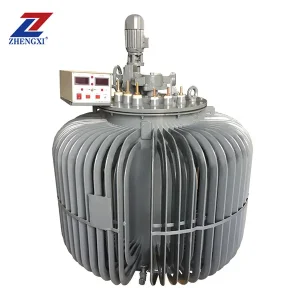
- The motor drives the sliding arm (carbon brush)
- The contact point on the autotransformer is adjusted
- Output voltage is stabilized to the rated value
This mechanical compensation method ensures:
- Smooth voltage regulation
- No step switching
- No additional waveform distortion
Key Advantages of Servo Voltage Stabilizers
- Large capacity capability – ideal for high-power single-phase loads
- High efficiency (up to 98%)
- No waveform distortion introduced
- Strong overload tolerance
- Stable performance under inductive, capacitive, resistive, and nonlinear loads
- Manual / automatic mode switching for flexibility
Compared with relay-type stabilizers, servo models provide continuous regulation rather than step-based correction, resulting in more stable output.
Electrical Parameters
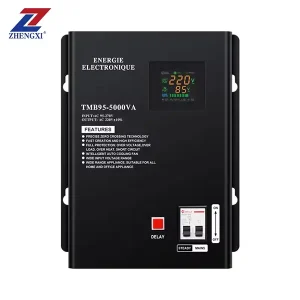
| 1 | Model | ADR 1Kva-60Kva | |
| 2 | Rated Capacity | 1Kva-60Kva | |
| 3 | Ac Input | Number Of Phases | Single Phase 1P+N |
| Rated Voltage | 220V±20% | ||
| Frequency | 50/60Hz | ||
| 4 | Ac Output | Number Of Phases | Single-Phase 1P+N |
| Rated Voltage | 220V±2% | ||
| Frequency | 50/60Hz | ||
| 5 | Output Rated Current | 4.55A-273A | |
| 7 | Load Work | Continuous Operation At 80% Load | |
| 8 | Productiveness | 98% | |
| 9 | Insulation Voltage | 2500V/Min No Breakdown | |
| 10 | Insulation Grade | F Level | |
| 11 | Cooling-Down Method | Dry Natural Cooling | |
| 12 | Regulation Accuracy | Factory setting: 2%V (adjustable from 1-5%) | |
| 13 | Dielectric Strength | 2500Vac/Min | |
| 14 | Noise | ≤60db (Excluding Forced Air Cooling Systems) | |
| 15 | Temperature Rise | ≤75℃ | |
| 16 | Output Voltage Setting Range | 220V±10% | |
| 17 | Bypass Function | Manual Bypass | |
| 18 | Defencive Function | Overvoltage, Undervoltage, Overcurrent, And Circuit Break Protection | |
| 19 | Status Indication | Normal, Avr, Fault, And Bypass Indicators | |
| 20 | Product Weight | About 55 (Kg) | |
| 21 | External Dimensions | 480 Mm Long, 360 Mm Wide, 580 Mm High | |
| 22 | Panel Display | Lcd Digital Display | |
| 23 | Certificate | Ce, Rohs, Iso9001 Certification | |
| 24 | Environment | Temperature | -10~40℃ |
| Relative Humidity | 15~90%(25℃) | ||
| Above Sea Level | <1500M | ||
| 25 | Defects Liability Period | The Entire Machine Is Covered By a 12-Month Warranty. | |
| 26 | After-Sale Service | Resolved Within 24 Hours | |
Custom specifications are available upon request.
Servo vs Other Technologies
Compared to relay-based stabilizers, servo models offer:
- Higher precision
- Smoother regulation
- Better load adaptability
While SCR stabilizers respond faster, servo stabilizers remain preferred for high-capacity, cost-sensitive, and mechanically robust applications.
Selection Guidance
When choosing a servo voltage stabilizer, consider:
- Select a scaled-up capacity of 2-3 times.
- Voltage fluctuation range
- Installation environment
- Continuous operation requirements
ZHENGXI provides engineering-based selection support to ensure optimal configuration.
FAQ
Q1: Does a servo stabilizer distort the waveform?
No. The regulation process does not introduce additional waveform distortion.
Q2: Is regular maintenance required?
Minimal maintenance is needed. Periodic inspection of carbon brushes is recommended for long-term operation.
Q3: Can this stabilizer operate continuously?
Yes, it is designed for continuous operation under rated conditions.
Conclusion
The Single-Phase Servo Automatic Voltage Stabilizer (ADR Series) remains a dependable and economical solution for voltage regulation. With proven mechanical design, high efficiency, and strong load adaptability, it continues to serve as a cornerstone technology in power conditioning systems worldwide.


 EN
EN  DE
DE  ES
ES  FR
FR  RU
RU  PT
PT  IT
IT  JA
JA  DA
DA  PL
PL  NL
NL  TR
TR