

Voltage Converter Manufacturer | Step Up & Step Down Transformers
Do you need to run equipment across different countries where the voltages are different?
ZHENGXI design and manufacture voltage converters (step-up and step-down transformers) for the conversion of electrical power for the purposes of running equipment safely and efficiently.
- Supports 110V / 120V / 220V / 230V / 240V
- Power range from 100VA to 500kVA (fully customizable)
- Built for industrial loads, continuous operation, and OEM integration


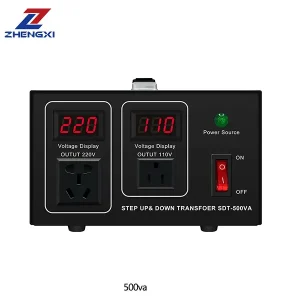
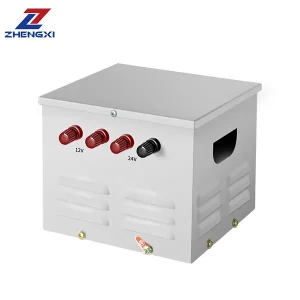
What Is a Voltage Converter?
A voltage converter can be defined as a tool used for changing the voltage from a certain level to another level. In most situations, this can be accomplished with a transformer.
Use a step-up transformer for 110V → 220V
Use a step-down transformer for 220V → 110V
Choose a transformer with a capacity 1.5+ times higher
How to Choose the Right Voltage Converter
Choosing the wrong model can lead to overheating, voltage drop, or equipment damage. Here’s a simple selection logic:
1. Identify input voltage
(e.g. 110V in the US, 220–240V in most other regions)
2. Confirm required output voltage
Match your equipment nameplate exactly
3. Calculate load power correctly
Resistive loads: ≥1.5×
Inductive loads (motors, compressors): ≥3×
4. Check frequency (important but often overlooked)
50Hz and 60Hz differences may affect motors, timing devices, and transformers
5. Consider the application environment
Indoor, outdoor, high temperature, or dusty industrial sites
Voltage Converter Calculator
Our Voltage Converter Types
Step-Up Transformer (110V to 220V)
Step Down Transformer (220V to 110V)
Isolation Transformer
Key Technical Specifications
| Parameter | Description |
|---|---|
| Power (VA / kVA) | Determines load capacity |
| Input Voltage | 110V / 220V / Custom |
| Output Voltage | Adjustable or fixed |
| Frequency | 50Hz / 60Hz |
| Efficiency | Up to 98% (depending on model) |
| Cooling | Air / Fan cooling |
| Protection | Overload / Short circuit |
Note: Specifications can be customized based on project requirements.
Typical Applications
Our voltage converters have a broad spectrum of uses that range from industrial machinery to automation systems, OEM export equipment, commercial cooking equipment, medical equipment, and construction sites where equipment is required to operate under different national voltage standards.
👉 Tell us your application – we’ll suggest the best configuration
Voltage Converter vs Other Power Devices
- Transformer → changes voltage only (no stabilization)
- Voltage stabilizer → stabilizes voltage but does not convert it
- Inverter → converts DC to AC (different function)
- UPS → provides backup power, not voltage conversion
👉 Not sure which one you need? Describe your setup — we’ll clarify quickly
Why Work With a Manufacturer (Not Just a Supplier)
From an engineering perspective, voltage converters are not “one-size-fits-all” products. Load type, startup current, duty cycle, and environment all affect performance and lifespan.
That’s why we focus on:
- 20+ years manufacturing experience in transformers
- OEM / ODM design based on real applications
- Flexible voltage, enclosure, and protection customization
- Reliable production lead time for bulk and project orders
- Technical support before and after delivery
Lead Time & Customization
Standard models: 5–10 days
Custom designs: 10–25 days
Bulk/project orders: flexible scheduling
We support customization of voltage, plugs, sockets, enclosure structure, and branding.
FAQ
What size voltage converter do I need?
Choose at least 20% higher than your device power. For motors or compressors, allow 3–5× startup capacity.
Can I run a 220V device on 110V?
Yes, using a step-up transformer.
Is a voltage converter the same as a transformer?
Most converters are transformers, but some include additional protection or control features.
Can I run multiple devices at the same time?
Yes — as long as the total load stays within the rated capacity.
When should I use an isolation transformer?
For sensitive, medical, or noise-critical equipment.
Incorrect voltage selection is one of the most common causes of equipment failure in international projects.
Send us your requirements — our engineers will review your application and recommend a suitable model with clear specifications and pricing.
 EN
EN  DE
DE  ES
ES  FR
FR  RU
RU  PT
PT  IT
IT  JA
JA  DA
DA  PL
PL  NL
NL  TR
TR