

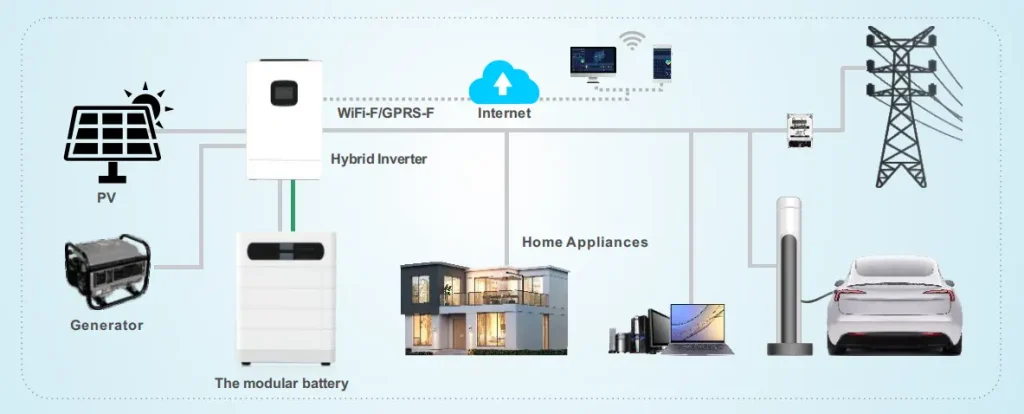
As global energy systems transition toward decentralization and renewable integration, hybrid inverters have become a cornerstone technology for modern solar power systems. If you are researching what is a hybrid inverter or evaluating whether a hybrid inverter is suitable for your application, this guide provides a clear, technically accurate, and industry-backed explanation.
Drawing on industry standards, manufacturer practices, and references from authoritative sources such as IEEE, ABB, Schneider Electric, and Wikipedia, this article explores hybrid inverter fundamentals, applications, market trends, technical characteristics, and selection guidance.
What Is a Hybrid Inverter?
A hybrid inverter is an advanced power conversion device that combines the functions of a solar inverter, battery inverter, and grid interaction controller into a single intelligent unit.
In practical terms, a hybrid inverter can:
Convert DC power from solar panels into AC power for household or industrial use
Manage battery charging and discharging
Interact with the utility grid (importing or exporting electricity)
Provide backup power during grid outages (when paired with batteries)
According to Wikipedia’s inverter classification, hybrid inverters belong to a broader category of multi-mode inverters, capable of operating in both grid-connected and off-grid conditions depending on system configuration.
Unlike traditional string inverters, hybrid inverters are designed for energy flexibility, enabling users to store excess solar energy and use it when grid power is unavailable or expensive.
How a Hybrid Inverter Works
At its core, a hybrid inverter continuously monitors energy flow and automatically selects the most efficient power source.
Typical operating modes include:
- Solar Priority Mode – Solar energy powers loads first, with surplus stored in batteries
- Battery Priority Mode – Stored energy is used during peak tariff periods
- Grid-Interactive Mode – Excess energy is exported to the grid (net metering supported)
- Backup Mode – Critical loads are powered by batteries during outages
This intelligent energy management is supported by microprocessor control, DSP algorithms, and communication protocols such as RS485, CAN, or WiFi.
IEEE publications on power electronics highlight that hybrid inverter topologies significantly improve system efficiency and reliability, especially in distributed generation environments.
Applications of Hybrid Inverters
Hybrid inverters are widely used across multiple sectors due to their adaptability.
Residential Applications
- Rooftop solar + battery storage
- Backup power for homes in unstable grid regions
- Self-consumption optimization under time-of-use tariffs
Commercial & Industrial Applications
- Small factories and workshops
- Retail stores requiring uninterrupted power
- Energy cost optimization and peak shaving
Remote & Hybrid Power Systems
- Telecom base stations
- Remote offices and clinics
- Solar-diesel-battery hybrid systems
Manufacturers such as ABB and Schneider Electric emphasize hybrid inverters as a key enabler for microgrids and distributed energy resources (DERs).
Market Trends and Industry Background
The global hybrid inverter market is expanding rapidly, driven by:
- Rising electricity prices
- Increased adoption of lithium-ion batteries
- Government incentives for solar + storage
- Grid instability in emerging markets
According to multiple energy outlook reports referenced by IEEMA and IEEE, energy storage integration is one of the fastest-growing segments in power electronics.
Hybrid inverters align perfectly with this trend, as they reduce system complexity by eliminating the need for separate battery inverters.
Key Technical Parameters
While specifications vary by model, most hybrid inverters are evaluated based on the following parameters:
- Rated Power Output (kW / kVA)
- PV Input Voltage Range
- Battery Voltage (typically 48V, 96V, or HV)
- Conversion Efficiency (up to 98%)
- Grid Standards Compliance (IEC, IEEE, CE)
- Protection Functions
- Over/under voltage
- Short circuit
- Anti-islanding
Compared to traditional inverters, hybrid inverters incorporate bidirectional DC-AC conversion, which adds complexity but significantly improves system capability.
Hybrid Inverter vs Other Inverter Types
【img】
alt: Comparison between hybrid inverter, on-grid inverter, and off-grid inverter
| Feature | Hybrid Inverter | On-Grid Inverter | Off-Grid Inverter |
|---|---|---|---|
| Battery Support | Yes | No | Yes |
| Grid Interaction | Yes | Yes | No |
| Backup Power | Yes | No | Yes |
| System Flexibility | High | Low | Medium |
From a system design perspective, hybrid inverters offer the best balance between flexibility, resilience, and long-term ROI.
How to Choose the Right Hybrid Inverter
Selecting the right hybrid inverter requires evaluating both technical requirements and application scenarios.
Key considerations include:
- Load type and peak power demand
- Battery compatibility (lead-acid or lithium)
- Grid regulations in your country
- Scalability for future expansion
- Manufacturer certifications (IEC, CE, ISO9001)
Established manufacturers often follow standards published by IEEE and IEC, ensuring grid safety and long-term reliability.
Why Choose a Professional Hybrid Inverter Manufacturer?
Working with an experienced manufacturer ensures:
- Proven design validated by international standards
- Stable firmware and long-term technical support
- OEM/ODM customization options
- Reliable after-sales service
Industry leaders such as ABB and Schneider Electric emphasize that inverter reliability directly impacts the entire lifecycle performance of a solar energy system.
FAQ
1. What is a hybrid inverter used for?
A hybrid inverter is used to manage solar power generation, battery storage, and grid interaction in a single system, enabling energy independence and backup power.
2. Can a hybrid inverter work without batteries?
Yes. Most hybrid inverters can operate like a standard on-grid inverter and allow batteries to be added later.
3. Is a hybrid inverter better than an on-grid inverter?
For users who want backup power, energy storage, or future expansion, a hybrid inverter offers significantly more flexibility than a traditional on-grid inverter.
Conclusion
Hybrid inverters represent the next evolution in solar power conversion technology. By combining solar, storage, and grid intelligence, they provide a future-proof solution for residential, commercial, and industrial energy systems.
As energy markets continue to evolve, choosing a high-quality hybrid inverter from a trusted manufacturer is a strategic investment in efficiency, reliability, and sustainability.




 EN
EN  DE
DE  ES
ES  FR
FR  RU
RU  PT
PT  IT
IT  JA
JA  DA
DA  PL
PL  NL
NL  TR
TR