

The automatic voltage stabilizer is a necessary tool for protecting electrical equipment against changes in voltage levels. In areas where there is instability within the power supply network or where there are highly inductive loads, using an automatic voltage stabilizer properly is directly related to maintaining equipment safety and functionality.
This article will demonstrate how an automatic voltage stabilizer can be used correctly and will describe principles and application examples. Questions and explanations in this article will be answered in the order they appear and will relate to the subject matter and IEEE guidelines and practices followed by companies such as ABB and Schneider.
What Is an Automatic Voltage Stabilizer?
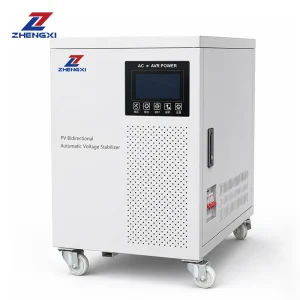
An Automatic Voltage Stabilizer is an electrical power conditioning device that regulates the output voltage to remain relatively constant within specified limits despite variations in the incoming supply. It continuously senses the input voltage and compensates for deviations to keep the output within a safe, predefined range.
Principal Internal Components
- Buck–boost transformer
- Servo motor system or solid-state (IGBT/SCR) circuit
- The voltage sensing and control unit
- Protection modules: overload, over-temperature, short circuit
Core function:
Provides a stable and safe voltage to the equipment connected even when the utility supply is unstable.
According to widely accepted electrical engineering references, voltage stabilizers are usually applied to areas where instability in the grid, load switching, or long-distance transmission losses may occur.
Why Proper Use of a Voltage Stabilizer Is Important
Inappropriate voltage stabilizer selection or its incorrect installation may lead to:
- Reduced voltage regulation accuracy
- Overheating or early component failure
- Insufficient protection for the equipment connected.
- Increased risk of more maintenance or even downtime
From a power quality standpoint, the IEEE guidelines cite that effective voltage regulation is a basic requirement for system reliability, particularly for industrial equipment and mission-critical loads.
Properly using a stabilizer is not optional but one part of responsible electrical system design.
Typical Application Areas
These voltage stabilizers are widely used in a number of industries:
Residential:Air Conditioners、Fridges and freezers、Home Entertainment Systems、Washing Machines
Commercial:Office IT and Networking Devices、Medical and laboratory devices、Elevators and escalators、Retail point of sales systems
Industrial:CNC Machines、Laser Cutting Machines、Computer Numerically Controlled Machines、Injection Molding Machines、
Printing presses、PLC and automation control systems
Companies like ABB and Schneider Electric usually recommend that voltage stabilizers be used in applications that are subjected to fluctuating voltages.

Step-by-Step: How to Use an Automatic Voltage Stabilizer Correctly
Step 1: Check Input Voltage Range
Before the installation, check if the rated voltage of the stabilizer suits the conditions at the site.
Typical ranges:
Single-phase: 140V–260V
Three-phase: 304V–456V
⚠️ Working outside the specified range may cause failure of the regulation system and/or internal damage.
Step 2: Choose the Correct Capacity (kVA Rating)
The sum of the various loads, including the starting current for motors, will always have to be calculated for the
Recommended safety margin:
| Load Type | Capacity Margin |
|---|---|
| Resistive load | ptional for magnification ≥ 2× |
| Inductive load (motors, compressors) | Optional for magnification ≥ 3× |
Such sizing logic meets industry standards for best practices, as mentioned by electrical manufacturing organizations.
Step 3: Installation and Wiring
Installation Checklist
- Installing it on a flat surface with good ventilation is required
- Ensure proper grounding (earthing)
- Connect input power to stabilizer input terminals
- Interconnect equipment to output terminals
- Secure all electrical connections tightly
When it comes to three-phase stabilizers, a certified electrician must verify the sequence and balance of phases are correct.
Step 4: Initial Power-On and Testing
After installation:
- Power on Stabilizer without Load
- “Verify input/output voltagereadings”:
- Verify the accuracy of the output voltage (usually ±1-10%)
- The connection to the load should only be done after obtaining stable readings
- This will prevent accidental damage to sensitive equipment.
Step 5: Daily Operation and Monitoring
It must be remembered that the latest voltage stabilizers work automatically. However, one must still:
- Check indicator panels periodically
- Monitor alarm messages or faulty messages
- Keep ventilation paths clear
Even the most advanced models could include such features as digital displays, remote monitoring, and the like.
Key Technical Parameters You Should Understand
When working with or choosing a stabilizer, one should:
- Rated capacity (kVA)
- Input voltage range
- Output voltage accuracy
- Response time
- Efficiency (%)
- Protection functions
These parameters have a direct impact on performance, especially in industrial applications involving dynamic or inductive loads.
Automatic Voltage Stabilizer vs Other Solutions
| Feature | Voltage Stabilizer | UPS | Isolation Transformer |
|---|---|---|---|
| Voltage regulation | ✅ Yes | ⚠️ Limited | ❌ No |
| Backup power | ❌ No | ✅ Yes | ❌ No |
| Electrical isolation | ⚠️ Moderate | ⚠️ Moderate | ✅ High |
| Cost efficiency | ✅ High | ❌ Lower | ⚠️ Medium |
For applications where continuous voltage correction is necessary without energy storage, the most economical solution still remains the automatic voltage stabilizer.
Industry Trends and Market Background
Analyzing power quality studies as recommended by IEEE, it is shown that voltage fluctuations have been the primary reason for the failure of electrical equipment all over the world.
Current trends include:
- Growing demand in emerging markets
- Increased use of digital and smart monitoring
- Shift toward solid-state stabilizers
- Higher efficiency and compact designs
With the increase in the complexity of the electrical grid, the importance of voltage stabilization remains unchanged.
How to Choose the Right Automatic Voltage Stabilizer
Before purchasing, evaluate:
- Single-phase or three-phase requirement
- Load type and starting current
- Ambient temperature and humidity
- Compliance with IEC / IEEE standards
- Manufacturer experience and certifications
The use of a stabilizer from a trusted manufacturer who has successful applications in industry can go a long way in avoiding operational risks.
FAQ
Q1: Is it possible for one stabilizer to power multiple devices
Yes, provided the total load remains within the rated capacity and voltage requirements are compatible.
Q2: Does a voltage stabilizer consume much energy?
No. Good-quality stabilizers work at 95 to 98% efficiency, losing negligible amounts of energy.
Q3: What is the typical service life?
When installed and maintained properly, an automatic voltage stabilizer will have a life span of 8 to 15 years based on the load conditions.
Conclusion
Use of an automatic voltage stabilizer not only encompasses its mounting process; it also requires knowledge related to load characteristics, power quality, and compatibility. If appropriately applied, a voltage stabilizer is an effective investment for protecting machinery and ensuring power safety.
For applications where power stability cannot be compromised, automatic voltage stabilizers remain a fundamental component of modern electrical systems.




 EN
EN  DE
DE  ES
ES  FR
FR  RU
RU  PT
PT  IT
IT  JA
JA  DA
DA  PL
PL  NL
NL  TR
TR