

Choosing the right pure sine wave inverter is essential for any off-grid, RV, marine, or backup power system. An appropriately sized inverter not only ensures reliable power delivery but also protects sensitive electronics from voltage spikes and distortion. This guide will walk you through each step of sizing a pure sine wave inverter so you can confidently select the ideal unit for your needs.
1. Calculate Continuous Load
- List Your Devices: Identify every appliance or device you plan to power (e.g., LED lights, laptops, refrigerators, pumps).
- Record Wattages: Note the continuous (running) wattage for each item.
- Sum Them Up: Add all continuous wattages to find your total steady-state load.
Example:
- LED lighting: 10 × 12 W = 120 W
- Laptop: 2 × 60 W = 120 W
- Mini fridge: 1 × 150 W = 150 W
- Water pump: 200 W
- Total continuous load = 590 W
2. Account for Surge (Peak) Load
- Understand Startup Currents: Motors and compressors often draw 2–5× their running wattage at startup.
- Identify Your Highest Surge: Check specs or use a clamp meter to measure inrush current.
- Ensure Peak Capacity: Your inverter’s surge rating must at least match the largest startup demand.
Example:
- Fridge startup: 150 W × 4 = 600 W
- Pump startup: 200 W × 3 = 600 W
- Required surge capacity ≥ 600 W (whichever is higher)
3. Apply a Safety Margin
Allow extra capacity to avoid overloading and to extend inverter life. A common rule is to add 20% to your continuous load:
Adjusted continuous load = Total continuous load × 1.2
Example: 590 W × 1.2 = 708 W
4. Consider Inverter Efficiency
Pure sine wave inverters typically operate at 85–95% efficiency. To size your battery bank and charging system, divide your adjusted load by the inverter’s efficiency:
Required input power = Adjusted continuous load ÷ Efficiency
Example: 708 W ÷ 0.90 ≈ 787 W
5. Match System Voltage
- 12 V, 24 V or 48 V?
- ≤ 1 kW systems: 12 V is common and compatible with many batteries.
- > 1 kW systems: 24 V or 48 V reduces current draw, lowers line losses, and allows thinner wiring.
6. Final Selection Checklist
- Continuous Rating ≥ adjusted continuous load (e.g., ≥ 800 W)
- Surge Rating ≥ highest startup requirement (e.g., ≥ 600 W)
- Input Voltage matches your battery bank
- Efficiency, certifications (CE, RoHS, ISO), and warranty
Summary
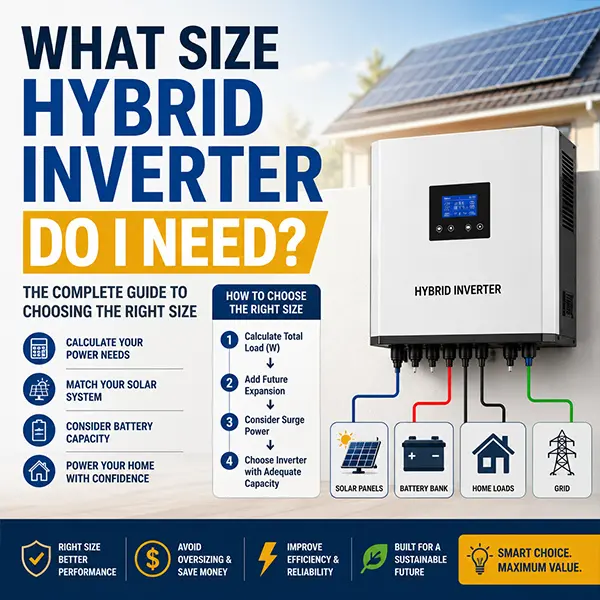
Sizing a pure sine wave inverter involves:
- Calculating your total continuous wattage,
- Accounting for surge loads,
- Adding a safety margin,
- Factoring in inverter efficiency,
- Selecting the correct DC input voltage.
Following these steps will ensure you choose an inverter that delivers stable, reliable power and maximizes the lifespan of both your inverter and connected equipment.
FAQ
Q1: What is the difference between continuous and surge power?
- Continuous power is the maximum load an inverter can handle indefinitely.
- Surge power is the short-term maximum to start motors or compressors.
Q2: Can I size the inverter exactly to my total load without a safety margin?
- It’s not recommended. A safety margin (typically 20%) prevents overload and allows for future expansion.
Q3: Why does system voltage matter?
- Higher voltage (24 V/48 V) lowers current for the same power, reducing heat in cables and improving efficiency.
Q4: How do I know my inverter’s efficiency?
- Consult the manufacturer’s datasheet. If unspecified, use a conservative estimate (~90%).
Q5: Are pure sine wave inverters necessary for all devices?
- While modified sine wave inverters work for simple loads, pure sine wave is required for sensitive electronics, variable-speed motors, and audio/video equipment.




 EN
EN  DE
DE  ES
ES  FR
FR  RU
RU  PT
PT  IT
IT  JA
JA  DA
DA  PL
PL  NL
NL  TR
TR