

A 100 kVA transformer is commonly used in industrial, commercial, and utility power distribution. One of the most frequently asked technical questions is:
how many amps does a 100 kVA transformer actually supply?
The answer depends on whether the transformer is a three-phase or single-phase transformer, as well as its operating voltage level.
Current Calculation for a 100 kVA Three-Phase Transformer
In a balanced three-phase system: I=kVA×1000/1.732×V
For a 100 kVA transformer at 400 V, the full-load current is: 𝐼=100 000/(1.732×400)≈144A
That means a standard 100 kVA three-phase transformer provides ~144 amps per phase at 400V.
High-Voltage Side (11 kV)
I=100 000 / (√3×11000)≈5.3A
✔ The primary current is very low due to the higher voltage.
Current Calculation for a 100 kVA Single-Phase Transformer
Although rare, a single-phase 100 kVA unit at 240 V would draw:
I=100 000/ 240≈ 417A,
✔ This massive current requires exceptionally large conductors
✔ This is why 100 kVA units are almost always designed as three-phase transformers
✔ Single-phase versions at this rating are special-order and unusual in real-world installations
3. Real World Operating Conditions (Power Factor Consideration)
A transformer is rated in kVA, not kW.
At power factor of 0.8: 100kVA×0.8=80kW (real usable power)
This is important because industrial loads rarely run at 1.0 PF.
Motors, compressors, welding machines, and inductive loads typically absorb reactive power.
4. Amp Ratings Must Not Be Exceeded
Operating above 144A at 400V leads to:
- Excessive copper and core heating
- Accelerated insulation aging
- Shortened transformer lifespan
- Higher I²R losses
- Potential thermal failure
Engineering rule:
✔ Transformers should operate at 60–80% of their rated load for continuous service.
✔ Overcurrent protection and good ventilation are critical.
5. Three-Phase vs Single-Phase: Which Is Better for 100 kVA?
| Feature | Single-Phase 100 kVA | Three-Phase 100 kVA |
|---|---|---|
| Typical usage | Rare, special-order | Standard |
| Current | ~417 A | ~144 A per phase |
| Conductor size | Very large | Normal industrial size |
| Efficiency | Lower | Higher |
| Cost | Higher | Lower |
| Heat management | Difficult | Balanced |
| Recommended for | Special utility networks | Industrial & commercial loads |
✔ Bottom line:
A 100 kVA transformer should be three-phase for almost all applications.
6. 100 kVA Transformer Price Guide (2025)
The transformer 100kVA price varies based on type and construction:
| Type | Typical Price (USD) | Notes |
|---|---|---|
| Oil-Immersed 100 kVA | $1,200 – $1,800 | Best cost-to-performance ratio |
| Dry-Type / Cast Resin 100 kVA | $1,600 – $2,500 | Ideal for indoor or fire-sensitive areas |
| Copper-winding premium version | +10–20% | Lower loss, heavier core |
| Custom-engineered unit | +15–40% | Special cooling, tap ranges, etc. |
Why the wide price range?
Because pricing depends on:
- Primary & secondary voltage
- Insulation class
- Copper vs aluminum windings
- IP protection rating
- Tap changer type
- Cooling & ventilation
- Compliance: CE / IEC / IEEE / UL
7. Recommended Global Transformers Manufacturers
Major industrial manufacturers of 100 kVA transformers include:
- ABB (Switzerland)
- Siemens (Germany)
- Schneider Electric (France)
- Mitsubishi Electric (Japan)
- Hyosung (South Korea)
- Eaton (USA)
- TBEA (China)
- ZHENGXI / SUNWAY (China – competitive OEM supplier)
✔ When sourcing from Chinese transformers manufacturers, pricing is often significantly more competitive with strong customization capability.
8. Summary
- A 100 kVA transformer at 400 V supplies ~144A per phase
- At 11 kV primary, current is only ~5.3A
- Single-phase 100 kVA = ~417A → impractical
- 100kVA transformer price = $1,200–$2,500 depending on design
- Best choice for this rating → three-phase oil-immersed
- Always consult the manufacturer’s technical datasheet for exact ratings
9. Want Help Sizing a 100 kVA Transformer?
If you’re unsure whether a 100 kVA transformer is right for your application, I can help you assess:
- Load type
- Starting current behavior
- Duty cycle
- Harmonic content
- Ambient temperature
- Installation environment
And recommend:
✔ Correct kVA rating
✔ Correct voltage configuration
✔ Correct transformer type
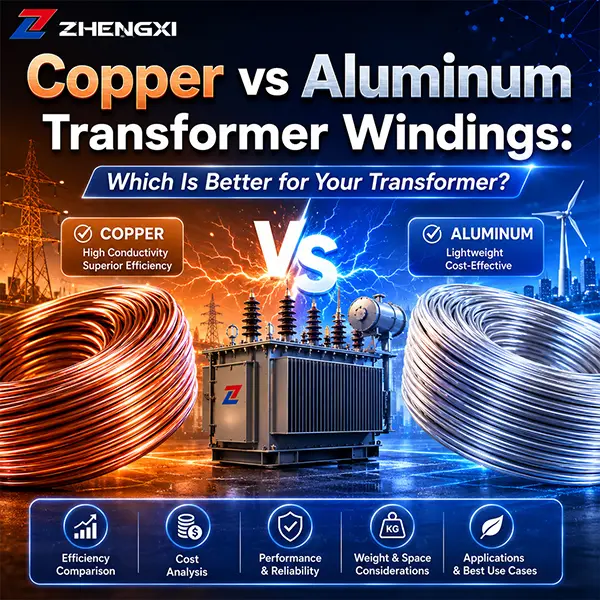
✔ Copper vs aluminum windings
✔ Recommended cooling method




 EN
EN  DE
DE  ES
ES  FR
FR  RU
RU  PT
PT  IT
IT  JA
JA  DA
DA  PL
PL  NL
NL  TR
TR