

The lifespan of a servo voltage stabilizer is not determined by a single factor. In real-world installations, it is the result of multiple interacting variables—design quality, electrical conditions, operating environment, load behavior, and maintenance practices.
In industrial and commercial applications, a properly sized and well-maintained servo voltage stabilizer typically operates reliably for 8–15 years. However, incorrect selection or harsh operating conditions can shorten its service life dramatically.
This guide explains, from an engineering and EEAT perspective, the key factors that directly influence the long-term reliability of servo voltage stabilizers.
Understanding the Lifespan of a Servo Voltage Stabilizer
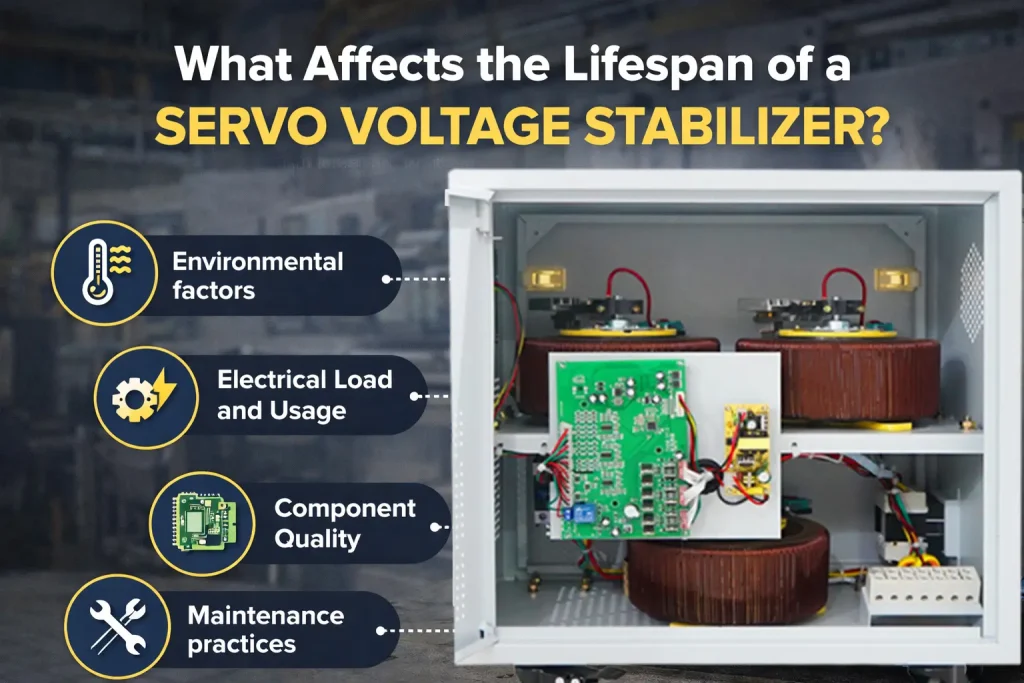
A servo voltage stabilizer is an electromechanical voltage regulation device that maintains stable output voltage using a servo motor, variac (autotransformer), control circuit, and carbon brush assembly.
Unlike static stabilizers, servo stabilizers rely on continuous mechanical movement. As a result, their lifespan is closely tied to mechanical wear, electrical stress, and thermal aging rather than electronics alone.
1. Quality of Core Components (Most Critical Factor)
The overall build quality of internal components has the greatest impact on service life.
Key components that determine durability include:
- Servo motor – Continuous-duty motors with copper windings offer longer operational life and better thermal stability
- Variac (autotransformer) – Copper-wound variacs outperform aluminum versions in heat resistance and insulation longevity
- Carbon brushes – High-density, self-lubricating brushes reduce friction and uneven wear
- Control PCB – Industrial-grade control boards with surge protection withstand voltage transients
- Cooling design – Proper ventilation or forced cooling prevents accelerated thermal aging
According to IEEE reliability models for electromechanical equipment, insulation degradation and motor wear are among the most common causes of early failure in voltage regulation systems.
2. Input Voltage Conditions and Fluctuation Severity
Servo stabilizers are designed to correct voltage variations, but excessive or continuous fluctuations significantly accelerate wear.
In practice:
- Wide voltage swings force near-continuous servo motor movement
- Frequent under- or over-voltage increases brush travel and heat generation
- Input voltage beyond the design range risks variac winding damage
For example, a stabilizer designed for ±15% correction that regularly experiences ±30% fluctuations will suffer rapid mechanical deterioration.
Industry references, including Wikipedia’s overview of automatic voltage regulators (AVR), note that sustained operation beyond rated limits greatly reduces service life due to constant regulation stress.
3. Load Characteristics and Load Percentage
For long-term reliability, servo stabilizers perform best when operating within 40%–80% of rated capacity.
Operating outside this range introduces problems:
- Overloading (>100%) leads to excessive heat and insulation breakdown
- Severe underloading (<20%) can cause frequent servo “hunting,” where small voltage deviations trigger repeated correction cycles due to low load inertia
Load type also plays a major role:
- Inductive loads (motors, compressors) create high inrush currents
- Non-linear loads (VFDs, CNC machines) introduce harmonics
- Rapid load changes increase servo motor activity and mechanical fatigue
IEEMA guidelines recommend higher design margins for stabilizers serving fluctuating industrial loads.
4. Operating Environment and Installation Conditions
Environmental conditions have a direct impact on stabilizer lifespan.
Common risk factors include:
- High ambient temperature, which accelerates insulation aging
- Dust and industrial pollution, increasing brush wear and tracking faults
- High humidity, leading to corrosion and PCB failures
- Poor ventilation, resulting in chronic overheating
Recommended operating conditions:
- Ambient temperature: 0–45°C
- Relative humidity: <90% (non-condensing)
- Clean, well-ventilated electrical rooms
IEEE thermal aging models indicate that every 10°C rise above rated temperature can reduce insulation life by up to 50%.
5. Frequency of Operation and Duty Cycle
Servo stabilizers are best suited for moderate fluctuation environments.
High-stress applications include:
- Unstable utility grids
- Generator-powered systems
- Remote or construction sites
In these scenarios, servo motors may operate almost continuously, accelerating brush wear and mechanical fatigue. For extremely unstable power systems, static or hybrid stabilizers often provide better long-term reliability.
6. Maintenance Practices (Often Overlooked)
Routine maintenance can significantly extend service life.
Recommended practices include:
- Periodic inspection and replacement of carbon brushes
- Cleaning of variac windings and internal dust
- Tightening of electrical connections
- Checking servo motor alignment
- Verifying control circuit calibration
Manufacturers such as ABB and Schneider Electric consistently emphasize preventive maintenance to avoid premature failures.
In practice, a stabilizer without maintenance may fail within 4–6 years, while a well-maintained unit can operate reliably for 12–15 years.
7. Design Margin and Engineering Standards
Not all servo stabilizers are engineered to the same standards.
High-reliability designs typically feature:
- Oversized servo motors
- Higher current-rated variacs
- Thermal sensors and overload protection
- Surge and spike suppression
Products compliant with IEC, IEEE, or IS standards generally offer longer operational life and improved safety margins.
8. Power Source Quality: Grid vs Generator
The power source directly affects wear patterns.
- Grid power is relatively stable and causes less mechanical stress
- Diesel generators introduce voltage and frequency instability, increasing servo movement
When operating with generators, the stabilizer must tolerate frequency variations and waveform distortion. Improper matching between generator output and stabilizer design is a common cause of early failure.
Typical Lifespan Expectations
| Operating Condition | Expected Lifespan |
|---|---|
| High-quality unit with regular maintenance | 12–15 years |
| Average industrial usage | 8–10 years |
| Harsh environment, no maintenance | 3–5 years |
Servo Stabilizer vs Static Stabilizer
| Feature | Servo Stabilizer | Static Stabilizer |
|---|---|---|
| Regulation accuracy | High (±1%) | Medium |
| Mechanical parts | Yes | No |
| Maintenance | Required | Minimal |
| Lifespan sensitivity | Higher | Lower |
| Best suited for | Heavy industrial loads | Electronics & IT |
Final Thoughts
The lifespan of a servo voltage stabilizer is engineered—not accidental. High-quality materials, proper sizing, stable operating conditions, and routine maintenance together determine whether a stabilizer becomes a long-term asset or a recurring failure point.
Backed by industry practices and guidance from IEEE, IEEMA, and leading manufacturers, informed selection and proactive maintenance remain the most effective ways to maximize service life and protect critical electrical loads.




 EN
EN  DE
DE  ES
ES  FR
FR  RU
RU  PT
PT  IT
IT  JA
JA  DA
DA  PL
PL  NL
NL  TR
TR