

How To Convert 3 Phase To Single Phase 220v: A Comprehensive Guide
If you only have access to 3-phase power but need to power equipment that takes single-phase power, you will need to convert the 3-phase power to a single-phase supply. With or without industrial equipment, workroom spaces, or home installations, being able to do this conversion will maximize the use of your electrical system.
Methods for Converting 3-Phase Power to Single-Phase
Converting 3-phase power to single-phase is not such a one-size-fits-all affair. Depending on your specific needs and equipment, there are several methods for doing so. Let’s talk about the most common ones:
1. Single-Phase Transformer Method
The simplest method of converting 3-phase power to single-phase is by using a single-phase transformer. This configuration involves placing a transformer in between two of the three phases of the 3-phase supply.
How it operates: A one-phase transformer exploits the voltage over two phases and provides an output in a one-phase power source. This is generally taken over small loads in which current balance distribution isn’t of prime concern.
Drawbacks: This strategy is efficient over loads up to approximately 10kVA on a 400V system. In heavy loads, taking up this strategy could mean an uneven distribution of currents that may be problematic to efficiency in equipment.
For a 10kVA system, the distribution of current would be as mentioned below:
- Phase 1: 26 Amps
- Phase 2: 26 Amps
- Phase 3: 0 Amps
This system is an inexpensive, simple solution for small applications.
2. Open Delta Transformer Method
For loads more than 10kVA, a more efficient, common technique is the Open Delta Transformer. This method is usually utilized in applications requiring up to 20kVA.
If you need a specific model or custom service, please submit your request through the contact form. We will get back to you as soon as possible.

Explore all ZHENGXI models, specifications, and technical parameters in one complete catalog. Find the right voltage solution for your project.
Are you looking for reliable suppliers and quality products? Fill out the form and send it to us — we’ll get back to you within 24 hours!

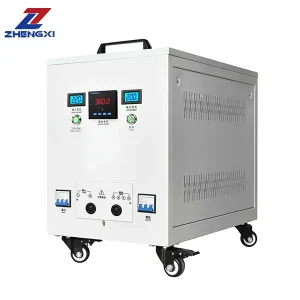
How it works: In the Open Delta configuration, only two out of the three phases are utilized. It is achieved by removing one of the coils from the 3-phase transformer core and thereby producing an unbalanced load. The main coils are loaded on two of the three supply lines, whereas the secondary coils are connected in a regular 3-phase star output.
Advantages: It ensures an even current distribution compared to the single-phase transformer method, especially for loads larger than 10kVA.
Example:
For 400V with a 10kVA load, current distribution among the three phases is as given below:
- Phase 1: 15 Amps
- Phase 2: 30 Amps
- Phase 3: 15 Amps
It is economical for large power demands and permits equalized loading.
3. Scott-T Transformer Method
The Scott-T transformer is another method that uses two single-phase transformers to produce a balanced single-phase output from a 3-phase source. This configuration is widely used in applications where both single-phase and 3-phase loads are to be fed from a 3-phase source.
It is driven by linking two of the three supply lines to the main transformer and linking the teaser transformer between the center tap of the main transformer and the third supply line.
Advantages: Scott-T transformers give more balanced and efficient single-phase outputs, particularly in loads from 10kVA to 30kVA, and it can be used either in one load or in numerous loads.
For a 10kVA load at 400V, the current distribution would be:
- Phase 1: 15 Amps
- Phase 2: 21.2 Amps
- Phase 3: 29 Amps
Scott-T transformers are well suited for providing balanced power to equipment that has both high running and starting power requirements.
4. Le-Blanc Transformer Method
Le-Blanc transformer is another advanced technique used for 3-phase to single-phase conversion. It is less commonly used but gives a highly efficient solution for medium power loads.
How it works: It uses a Le-Blanc transformer, and the transformer can support loads of up to 10kVA with a balanced single-phase output. The transformer distributes the load evenly across the three phases such that the output is stable and efficient.
Advantages: It provides a more efficient level compared to other methods, particularly for loads that require stable voltage and current.
Example
For 10kVA load at 400V, the division of current is:
Phase 1: 7.8 Amps
Phase 2: 21.2 Amps
Phase 3: 29 Amps
This transformer offers greater voltage balance and is appropriate for applications that have average power demands.
5. Why Use a Phase Converter?
While transformers are commonly used for 3-phase to single-phase conversion, phase converters are also a popular alternative, especially when you have equipment that can be operated on a single-phase system but only have access to 3-phase power.
Rotary Phase Converters: These are ideal for heavy-duty equipment like welders or CNC machines.
Static Phase Converters: These are simpler and cheaper but less efficient for heavy machinery.
Choosing the Right Solution
The best solution to convert 3-phase to single-phase 220V depends on the following:
Load Size: For small loads, a single-phase transformer would suffice, while large loads can be addressed by using Scott-T or Open Delta transformers.
Efficiency Requirements: If you desire a highly efficient solution, then Le-Blanc transformers or Scott-T transformers can be employed for better current distribution.
Cost and Complexity: The single-phase transformer method is most cost-effective but is used in small applications only.
Conclusion
3-phase power can be converted to single-phase 220V using various methods, all suited for the size of load and efficiency need. Whether a single-phase transformer, an Open Delta transformer, a Scott-T transformer, or a Le-Blanc transformer is used, the key thing is to couple the method to your own demands. Knowing the differences between the methods, you can make an informed decision based on your setup.
For bigger or more intricate industrial installations, it’s best to seek the advice of a professional electrical engineer to make sure the proper method and equipment is selected for your requirements.
 EN
EN  DE
DE  ES
ES  FR
FR  RU
RU  PT
PT  IT
IT  JA
JA  DA
DA  PL
PL  NL
NL  TR
TR