

Stabilizer for Photocopier Machine
In today’s fast-paced office and production environments, photocopiers and high-volume printers have become indispensable assets—yet they are among the most sensitive pieces of office equipment. Fluctuations in mains voltage—whether surges, sags, brownouts, or spikes—are silent but costly threats to their delicate electronics.
Unstable power doesn’t just cause downtime; it can degrade print quality, shorten equipment lifespan, and increase maintenance costs. Automatic voltage stabilizer for printer or photocopier machine acts as a protective shield, delivering clean, consistent power that ensures:
- Continuous, high-quality output
- Reduced mechanical wear and tear
- Lower risk of sudden breakdowns
- Extended service life for costly components

Understanding the Technology: What is a Voltage Stabilizer for Office Equipment?
A voltage stabilizer—also known as an Automatic Voltage Regulator (AVR)—is designed to keep the output voltage stable (e.g., 110V, 120V, 220V, or 230V AC) despite fluctuations in the incoming supply.
It works by:
- Boosting voltage when mains power dips (brownouts or sags)
- Buckling voltage when mains power rises above safe limits (surges or swells)
Modern stabilizers for copiers and printers maintain tight voltage accuracy (±1% to ±3%), ensuring uninterrupted performance even in challenging power environments.
Why printers and copiers are vulnerable:
- Precision motors for paper feeding and drum operation
- High-wattage heating elements in the fuser unit
- Sensitive control boards with microprocessors
- Optical and mechanical sensors for alignment and paper detection
Without voltage stabilization, these components risk:
- Burnout or premature aging
- Fuser underheating/overheating
- Mechanical jams and misfeeds
- Data corruption or system crashes
Where Voltage Stabilizers Are Essential
- Corporate Offices – Safeguarding departmental printers and copiers
- Print Shops & Reprographics Centers – Protecting high-speed production printers
- Educational Institutions – Ensuring uptime in libraries and administrative offices
- Government & Legal Departments – Supporting uninterrupted document workflows
- Healthcare Facilities – Protecting administrative and patient record printing systems
- Industrial Complexes – Stabilizing printers in environments with heavy machinery power loads
- Areas with Unstable Power – Regions prone to voltage instability or frequent storms
Global Market & Industry Insights
The reliance on digital printing and high-volume documentation continues to rise. According to the Electric Power Research Institute (EPRI), power quality issues cost U.S. businesses billions of dollars annually through equipment damage and downtime.
The IEEE 1159 standard clearly identifies voltage sags and swells as the most common power disturbances affecting sensitive electronics. As highlighted by Wikipedia’s “Voltage Regulation” entry, stable voltage is fundamental in electrical engineering—especially for high-performance office equipment.
In emerging markets and developing regions, inconsistent grid performance has accelerated the adoption of non-contact voltage stabilizers for mission-critical applications. Manufacturers like ABB, Schneider Electric, and Siemens also stress that 3 phase voltage stabilizers are vital in environments where large-format printers or multiple devices are connected to shared power circuits.
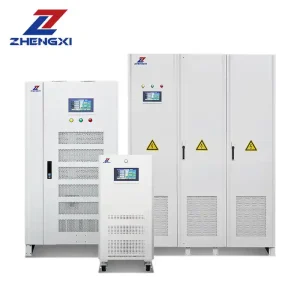
ZHENGXI’s Non-Contact Voltage Stabilizer Advantage
At ZHENGXI, we specialize in non-contact servo-controlled stabilizers—offering superior speed, reliability, and precision compared to relay-based or tap-changing designs.
How Non-Contact (Servo) Stabilizers Work:
- A servo motor adjusts a carbon brush position without direct electrical contact on the autotransformer winding.
- Sophisticated control circuits monitor input voltage in real-time.
- Voltage is corrected seamlessly and without steps, ensuring zero output interruption.
- The result is pure sine wave output with minimal waveform distortion.
Key Technical Benefits:
- Input Voltage Range: ±15% to ±50% (model dependent)
- Output Accuracy: ±1% to ±3%
- Response Time: <5 ms for static designs, <1s for servo designs under large changes
- Efficiency: >95% to reduce energy waste
- Noise: Near-silent operation
- Overload Protection: Integrated breakers/fuses
- Capacity Range: From 1–5kVA for single devices to over 30kVA for 3 phase voltage stabilizer solutions
Relay vs. Servo vs. Non-Contact Stabilizers – Which is Best for Your Copier?
| Feature | Non-Contact Servo | Relay-Type | Basic Surge Protector/UPS |
|---|---|---|---|
| Correction | Seamless, step-less | Stepped, visible jumps | Cut-off only |
| Speed | Ultra-fast (<5ms) | Slower (20ms–seconds) | Fast (surge cut-off) |
| Output Waveform | Pure sine | Possible distortion | Passes input/battery |
| Maintenance | Very low | Requires contact replacement | Low |
| Best Use | Critical copiers/printers | Budget-friendly, mild loads | Minor surge protection only |
Choosing the Right Stabilizer for Your Printer or Copier Fleet
Calculate Load (kVA) – Convert the total wattage of the equipment to kVA (watts), allowing a 2–3x margin.
Match Voltage & Phase –
- Single-phase stabilizers for standard office units.
- 3 phase voltage stabilizer for large industrial copiers or multiple high-load devices.
Check Input Range – Choose a model with wider tolerance than your site’s worst fluctuation.
Select Technology – For mission-critical uptime, opt for a non-contact voltage stabilizer.
Review Certifications – Look for ISO, CE, ROHS compliance.
Consider Environment – Ensure proper IP rating for dust, humidity, or heat.
FAQ
Q1: Can one stabilizer protect multiple printers and copiers?
Yes—calculate the total load and select a stabilizer with sufficient capacity and safety margin. For larger setups, a 3 phase voltage stabilizer is ideal.
Q2: How is a stabilizer different from a UPS?
A stabilizer regulates voltage but does not provide backup power. A UPS provides short-term power during outages but may have limited regulation ability. For best protection, pair a stabilizer with a double-conversion UPS.
Q3: Why choose non-contact stabilizers over relay types?
They offer faster correction, cleaner output, silent operation, and longer lifespan—critical for sensitive print equipment.
Secure Your Printing Infrastructure
An unstable power supply can quietly damage your most valuable office assets. Investing in a high-performance voltage stabilizer for your printers and copiers, especially an IGBT static voltage stabilizer with contactless technology, is a proactive and cost-effective safeguard.
Related products


 EN
EN  DE
DE  ES
ES  FR
FR  RU
RU  PT
PT  IT
IT  JA
JA  DA
DA  PL
PL  NL
NL  TR
TR