

In modern industrial and commercial power systems, maintaining stable and clean electricity is critical for equipment reliability and operational safety. A 3 phase isolation transformer plays an important role in protecting electrical systems from voltage disturbances, electrical noise, surges, and grounding problems.
From CNC machinery and medical equipment to renewable energy systems and data centers, 3-phase isolation transformers are widely used wherever dependable power quality is required.
This article explains how a 3-phase isolation transformer works, its advantages, applications, technical specifications, and how to choose the right model for industrial use.
What Is a 3 Phase Isolation Transformer?
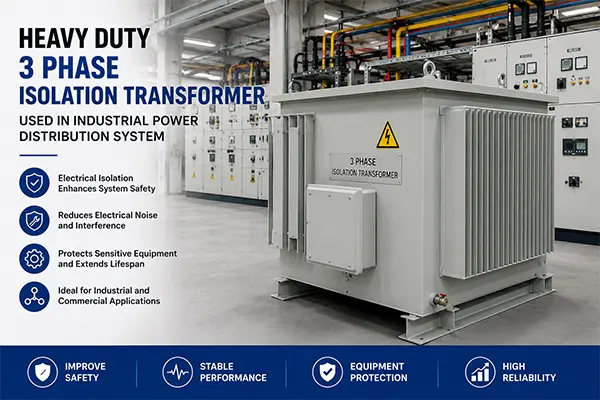
A 3-phase isolation transformer is a transformer that transfers electrical energy between two separate 3-phase AC circuits through electromagnetic induction while keeping the input and output electrically isolated.
Unlike an autotransformer, the primary winding and secondary winding are completely separated. This design provides:
- Electrical isolation
- Noise suppression
- Improved grounding
- Surge protection
- Enhanced equipment safety
Isolation transformers are commonly designed for voltage conversion as well, such as:
- 480V to 208V
- 415V to 380V
- 600V to 400V
According to IEEE electrical power standards, isolation helps improve system reliability and reduces risks associated with transient voltage and grounding faults.
How Does a 3 Phase Isolation Transformer Work?
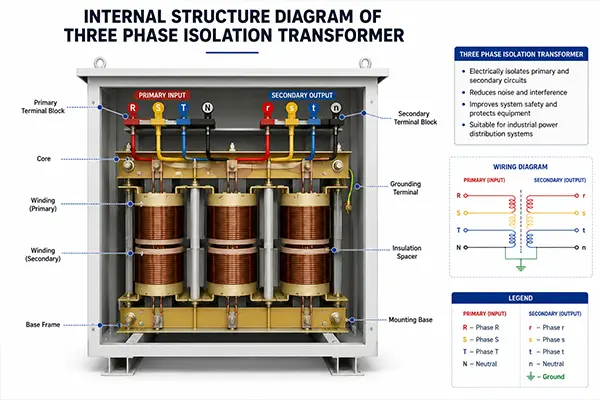
A 3-phase isolation transformer operates based on Faraday’s Law of Electromagnetic Induction.
When alternating current flows through the primary winding, a magnetic field is generated in the transformer core. This magnetic flux induces voltage in the secondary winding without direct electrical contact.
The basic transformer relationship is:
Where:
- = Primary voltage
- = Secondary voltage
- = Primary winding turns
- = Secondary winding turns
Because the two windings are isolated, electrical noise and fault currents are significantly reduced.
Common Winding Configurations
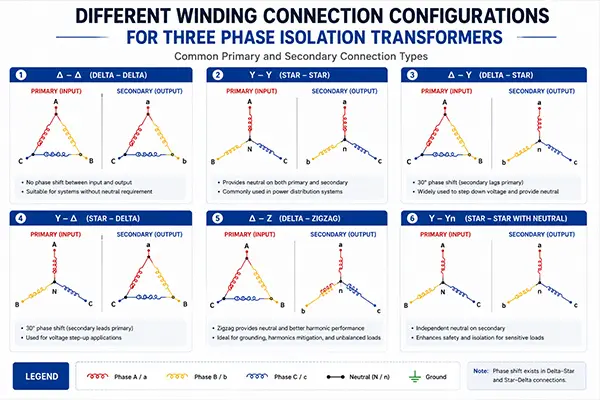
Different industrial systems require different transformer connections.
Delta-Delta (Δ-Δ)
- Suitable for balanced industrial loads
- Good harmonic handling capability
- Common in motor applications
Delta-Wye (Δ-Y)
- Provides neutral grounding
- Frequently used in commercial distribution systems
Wye-Delta (Y-Δ)
- Often used for motor starting applications
- Helps reduce harmonic distortion
Wye-Wye (Y-Y)
- Used in high-voltage transmission systems
- Requires careful grounding design
Key Advantages of 3 Phase Isolation Transformers
1. Electrical Isolation for Safety
The biggest advantage is complete galvanic isolation between input and output circuits.
This helps protect equipment from:
- Electrical shock
- Ground loops
- Fault propagation
- Voltage spikes
In sensitive environments such as hospitals and laboratories, isolation is essential for operational safety.
2. Power Quality Improvement
Industrial facilities often suffer from:
- Electromagnetic interference (EMI)
- Radio frequency interference (RFI)
- Harmonic distortion
- Switching transients
Isolation transformers help reduce these disturbances and provide cleaner power to sensitive equipment.
3. Voltage Conversion Capability
Many isolation transformers also function as step-up or step-down transformers.
Examples include:
| Input Voltage | Output Voltage | Typical Application |
|---|---|---|
| 480V | 208V | CNC machinery |
| 415V | 380V | Export equipment |
| 600V | 400V | Industrial automation |
4. Improved Equipment Lifespan
Stable voltage and reduced electrical stress can extend the service life of:
- PLC systems
- Servo drives
- UPS equipment
- Medical imaging systems
- Industrial robots
Applications of 3 Phase Isolation Transformers
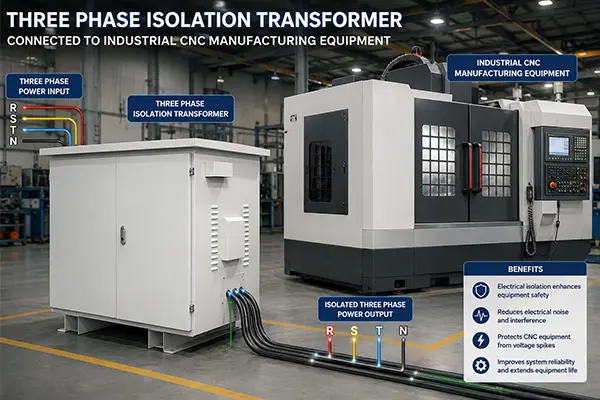
Industrial Manufacturing
Factories use isolation transformers to protect:
- CNC machines
- Variable frequency drives (VFDs)
- Robotics systems
- Automated production lines
Data Centers and IT Infrastructure
Data centers require stable and noise-free power to prevent downtime and protect servers.
Isolation transformers help reduce common-mode noise and improve power conditioning.
Renewable Energy Systems
Solar and wind power systems use isolation transformers for:
- Grid isolation
- Inverter protection
- Voltage matching
- Harmonic reduction
Companies such as ABB and Schneider Electric continue investing in advanced transformer technologies for renewable energy integration and smart grid infrastructure.
Medical and Healthcare Facilities
Medical equipment is highly sensitive to electrical interference.
Isolation transformers are widely used in:
- MRI systems
- Operating rooms
- Diagnostic equipment
- ICU power systems
They help improve patient safety and reduce leakage current risks.

3 Phase Isolation Transformer vs Autotransformer
Many buyers compare isolation transformers with autotransformers before purchasing.
| Feature | Isolation Transformer | Autotransformer |
|---|---|---|
| Electrical Isolation | Yes | No |
| Noise Filtering | Excellent | Limited |
| Safety Level | High | Moderate |
| Size | Larger | Smaller |
| Cost | Higher | Lower |
| Surge Protection | Better | Limited |
An autotransformer is more compact and economical, but it cannot provide true electrical isolation.
For sensitive equipment and industrial automation, isolation transformers are generally the safer and more reliable choice.
Technical Specifications to Consider
When selecting a transformer, several parameters should be evaluated carefully.
Power Rating
Typical ratings range from:
- 1 kVA
- 10 kVA
- 100 kVA
- Up to several MVA
Always allow additional capacity for future expansion.
Efficiency
Modern high-efficiency transformers typically achieve:
- 95% to 99% efficiency
Low-loss silicon steel cores and copper windings help reduce energy consumption.
Insulation Class
Common insulation classes include:
- Class F
- Class H
Higher insulation classes support elevated operating temperatures.
Cooling Methods
Dry-Type Cooling
- Air cooled
- Lower maintenance
- Indoor installation
Oil-Immersed Cooling
- Better heat dissipation
- Suitable for large-capacity outdoor systems
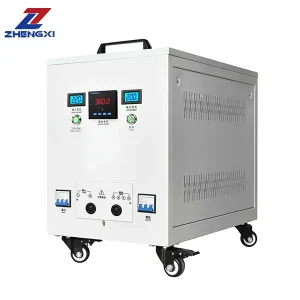
【img】
alt: Dry type three phase isolation transformer for indoor commercial installation
Market Trends and Industry Development
The global transformer industry continues to expand due to several major trends:
- Growth of Industry 4.0
- Smart factory development
- Renewable energy adoption
- Increasing power quality requirements
- Expansion of EV charging infrastructure
Industry organizations such as IEEMA and technical resources like Wikipedia Transformer Overview highlight the increasing demand for energy-efficient transformer technologies worldwide.
Manufacturers are now focusing on:
- Low-loss core materials
- Compact designs
- Smart monitoring systems
- Eco-friendly insulation materials
How to Choose the Right 3 Phase Isolation Transformer
Selecting the correct transformer depends on multiple factors.
Determine Load Requirements
Calculate total load demand in:
- kVA
- Voltage
- Current
- Starting current requirements
Consider Harmonic Loads
For systems using:
- VFDs
- UPS systems
- Rectifiers
- Data center equipment
Choose a transformer designed for harmonic mitigation or K-factor ratings.
Check Installation Environment
Evaluate whether the transformer will operate in:
- High humidity
- Dusty conditions
- High ambient temperature
- Outdoor environments
Appropriate enclosure protection such as IP-rated cabinets may be required.
Verify Compliance Standards
Look for compliance with:
- IEEE standards
- IEC standards
- UL certification
- CE certification
This helps ensure reliability and long-term operational safety.
FAQ
Its main purpose is to electrically isolate the power source from the load while improving safety, reducing electrical noise, and protecting equipment.
Yes. Although it does not completely eliminate harmonics, it can reduce common-mode noise and improve overall power quality, especially when combined with harmonic mitigation designs.
Dry-type transformers use air cooling and are suitable for indoor applications, while oil-filled transformers provide better cooling efficiency for high-power outdoor installations.
Conclusion
A 3 phase isolation transformer is a critical component in modern electrical infrastructure. By providing electrical isolation, voltage conversion, noise suppression, and enhanced safety, these transformers help protect sensitive industrial and commercial equipment from unstable power conditions.
As industries continue moving toward automation, renewable energy integration, and intelligent power management, demand for high-efficiency isolation transformers will continue growing across global markets.
For businesses seeking reliable power protection and improved operational stability, selecting the right isolation transformer is a long-term investment in system performance and electrical safety.




 EN
EN  DE
DE  ES
ES  FR
FR  RU
RU  PT
PT  IT
IT  JA
JA  DA
DA  PL
PL  NL
NL  TR
TR