

Unstable voltage can make family appliances or factories equipment damaged or even hurt. The servo voltage stabilizer has become a powerful tool for solving voltage fluctuations with efficient and precise voltage regulation functions. In the dazzling variety of products on the market, just how to avoid mistakes and choose the right servo voltage stabilizer? This article will help you solve it!
1. First, figure out what you need, don’t choose randomly!
1. Confirm the load type and power requirements
Different devices have different requirements for servo voltage stabilizers:
Ordinary household appliances (such as refrigerators and TVs): Relay or servo voltage stabilizers of general power can meet the needs.
Inductive load equipment (such as air conditioners and motors): The current is large during startup, and the voltage stabilizer power needs to be more than 3 times the power of the equipment. For example, a 250W motor should choose a voltage stabilizer of more than 750KVA.
Precision instruments, medical equipment, and laboratory equipment all require high precision, high power voltage stabilizers to guarantee voltage stability for the safe operation of the equipment.
2. Is the voltage fluctuation at home or in the factory large?
The fluctuation range of the power grid voltage varies in different areas, so it needs to be asked from neighbours or measured using a voltmeter. According to the size of the fluctuation, it is necessary to select a suitable voltage stabilizer for local voltage fluctuations. Such as industrial equipment, generally requiring a servo voltage regulator of 300–460V AC which could fight with complicated power grid environment.
2. How to choose the core parameters of servo voltage stabilizer? Just look at these!
1. Voltage stabilization accuracy
The higher the output voltage accuracy, the better the effect of voltage stabilization, but the price is also relatively high. For household appliances, a relay voltage stabilizer or servo voltage stabilizer can be selected for an accuracy of ±3%~±10%. Generally speaking, the accuracy of servo voltage stabilizer for factory equipment shall be selected to be within ±3%, while that of static voltage regulator should be ±1% when precise instruments and apparatus are concerned.
2. Response time
Fast response effectively protects the equipment. Choose the servo voltage stabilizer whose response time is less than 1s.
3. Efficiency
High efficiency=more power saved. When using a servo voltage stabilizer, choose an efficiency of >95% to save long-term operating costs.
4. Protection function
The protection functions such as overvoltage, undervoltage, short circuit, and overload should be equipped in the servo voltage stabilizer to guarantee the safety of the equipment.
5. Phase selection
Choose a voltage stabilizer with the corresponding number of phases according to whether the electrical equipment uses single-phase or three-phase electricity.
For example, a single-phase voltage stabilizer should be selected for household single-phase electricity. A three-phase servo voltage stabilizer should be selected for industrial equipment.
III. Consider the size and installation method
To choose appropriate equipment for the conditions of installation:
In a compact space environment, you can choose a compact and wall-mounted servo voltage regulator.
Demand for large equipment: Select the ground equipment and leave enough space for heat dissipation.
IV. Brand and after-sales service are also important
1. Choose a reliable brand
Well-known brands use better materials and more stable quality. For example, ZHENGXI Electric, a well-known Chinese voltage stabilizer manufacturer and supplier, provides customers with diversified customized services to meet the needs of different countries and industries.
2. Pay attention to after-sales service
Also, ask about the warranty period and maintenance point distribution and other information for ensuring the problems can be solved in time.
5. Recommended actual selection cases
Due to different device requirements, several suitable suggestions are as follows:
TNS15kVA-50kVA: The small and middle-sized equipment starting power is suitable for 5kVA ~ 15kVA, for example, for household equipment or ordinary industrial use.
TNS60kVA-120kVA: for high-power equipment, starting power is between 20kVA and 40kVA, welding equipment, and precision instrument.
6. Summary
Choosing a servo voltage regulator is just like buying shoes, only when it fits well, will it feel comfortable!
Figure out the needs first: load type, power, voltage fluctuation;
Look at the core parameters: voltage stabilization accuracy, response speed, efficiency and protection function;
Choose a reliable brand and after-sales service.
Hopefully, this article can help you pick the right servo voltage stabilizer and use electricity safely. Questions? Leave a message in the comment area!
Related Products
-
 3KVA-50KVA Single Phase Servo Automatic AC Voltage Stabilizer
 -
 SBW 60kva-300kva outdoor 3 phase servo automatic voltage stabilizer rainproof type
 -
 China TND 1Kva-5Kva Single Phase Servo Motor Control Intelligence Automatic Ac Voltage Stabilizers
 -
 Servo Voltage Stabilizer for Welding Machine
 -
 STB 1KVA-12KVA Single Phase Servo Automatic Voltage Stabilizers
 -
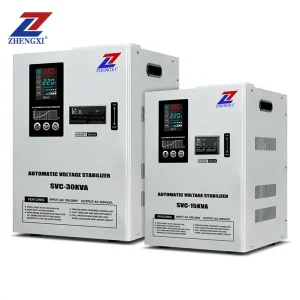 SVC-5Kva 8Kva 10Kva 15Kva 20Kva 30Kva Servo Single Phase Virtical Type Voltas Digital Voltage Stabilizer


 EN
EN  DE
DE  ES
ES  FR
FR  RU
RU  PT
PT  IT
IT  JA
JA  DA
DA  PL
PL  NL
NL  TR
TR