

Autotransformers and traditional transformers are both common electrical equipment in power systems. They both use the principle of electromagnetic induction to adjust the voltage, but they are very different in structure, working principle and application occasions. The following is a comparison between the two:
Autotransformer vs. Traditional Transformer Comparison Chart
| Feature | Autotransformer | Traditional Transformer |
| Structure1 | Primary and secondary share part of the winding | Primary and secondary have separate windings |
| Voltage Conversion Principle | Partial shared windings, voltage changes according to winding ratio | Complete isolation, voltage change based on turns ratio |
| Voltage Ratio Range | Suitable for voltage ratios of up to 2-3 times | Can handle larger voltage ratios |
| Efficiency | High efficiency, low loss | Slightly lower efficiency due to more windings and losses |
| Size & Weight | Compact, lightweight | Bulkier, heavier |
| Cost | Lower cost | Higher cost |
| Electrical Isolation | No complete electrical isolation, lower safety | Complete electrical isolation, higher safety |
| Applications | Motor starting, voltage regulation | High voltage transmission, applications requiring electrical isolation |
| Safety | May cause over-voltage issues, requires additional protection | High safety, suitable for high-risk environments |
What are the advantages and disadvantages of autotransformer?
Advantages
1) Higher efficiency:
Because the windings of the autotransformer are shared, the energy transfer loss is smaller and it is more efficient than traditional transformers. It is particularly suitable for applications that require high efficiency and low power.
2) Smaller size and weight:
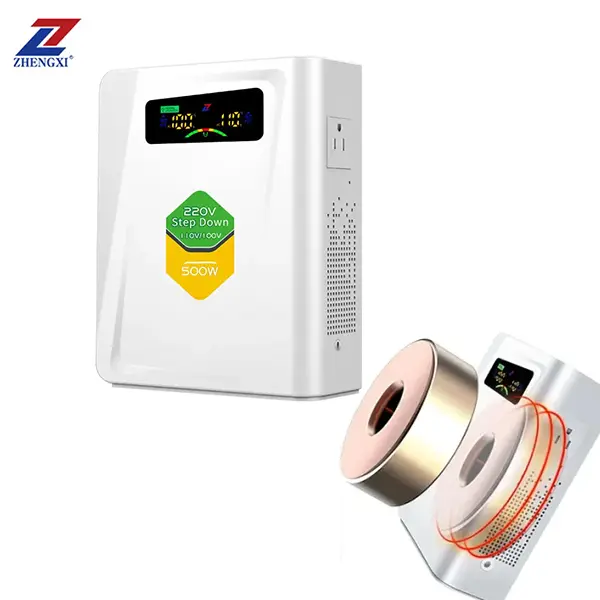
Because there are fewer windings and less material required, the autotransformer is small and light. This saves space and is particularly suitable for applications with limited space.

Disadvantages
(1) Limited voltage conversion range
The voltage conversion of the autotransformer is achieved through the turns ratio of the windings, but because their windings are shared, the voltage conversion range is usually small. Generally speaking, it is suitable for applications where the voltage ratio does not exceed 2-3 times. If a larger range of voltage conversion is required, a traditional transformer is more suitable.
(2) Poor electrical isolation
The primary and secondary windings of the autotransformer share part of the winding, which means that there is no complete electrical isolation between them. In some situations where strict electrical isolation is required, such as high voltage or sensitive equipment, it may not be safe to use an autotransformer.
Summary
The main difference between transformer and autotransformer
Autotransformer is suitable for occasions with small voltage ratio change, high efficiency and energy saving, and low requirements for electrical isolation, such as motor starting, voltage regulation, etc.
Traditional transformers are more suitable for occasions that require high electrical isolation and large voltage ratio, such as high-voltage power transmission, protection of power networks and isolation of electrical equipment.
In general, autotransformers have the advantages of high efficiency, energy saving, small size and low cost, and are widely used in industry, transportation and new energy fields. However, in occasions that require high safety, voltage isolation or large voltage conversion, traditional transformers are still a better choice.
- How many windings are normally found in an autotransformer
The biggest difference between an autotransformer and a traditional transformer is the number of windings. A traditional transformer has two completely independent windings, one primary and one secondary. An autotransformer has only one winding, which is used as both the primary and secondary windings. The primary and secondary achieve voltage conversion by sharing part of the winding. ↩︎
Related Products
-
 Heavy Duty 5000W Voltage Converter Transformer | Step Up/Down 110-220V | Circuit Breaker Protection
 -
 DZW 220v to 380v single phase to 3 phase transformer
 -
 DG 3kva-30kva Single Phase Dry Type Auto Transformer
 -
 SBK 0.3Kva-5Kva Three-Phase Dry Type Isolation Transformer
 -
 BK industrial control power transformer 440v to 220v 0.1kva-5kva
 -
 QSG 10kva-100kva 3 Phase Dry-Type Autotransformer



 EN
EN  DE
DE  ES
ES  FR
FR  RU
RU  PT
PT  IT
IT  JA
JA  DA
DA  PL
PL  NL
NL  TR
TR