

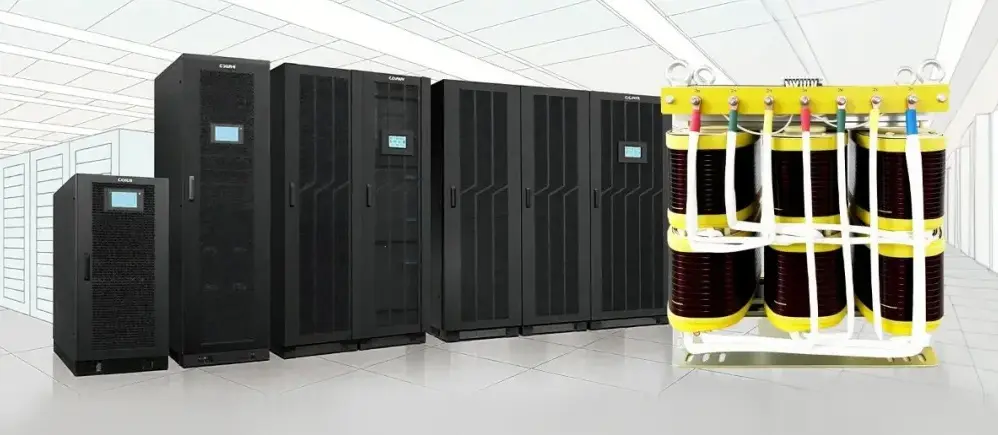
A UPS Transformer is a key component that ensures stable, clean, and reliable power for sensitive electrical loads. Whether used in data centers, medical equipment, industrial automation, or home backup systems, the transformer inside—or connected to—a UPS plays a critical role in voltage adaptation, isolation, and protection.
Despite its importance, many users misunderstand how UPS transformers work. Choosing the wrong voltage, capacity, or connection method can lead to overheating, tripping, equipment failure, or even complete UPS shutdown. This guide explains everything you need to know before selecting a UPS transformer.

1. What Is a UPS Transformer?
A UPS Transformer is a transformer used in or alongside an Uninterruptible Power Supply (UPS) to perform one or more of the following functions:
- Voltage Conversion
Adapts grid voltage to the appropriate UPS input or output level.
- Electrical Isolation
Blocks electrical noise, improves safety, and isolates the load from grid disturbances.
- Harmonic Filtering & Stabilization
Mitigates harmonics generated by rectifiers, inverters, and nonlinear loads.
- Power Conditioning
Ensures the UPS delivers clean, stable, and consistent voltage.
UPS transformers may be built-in (inside the UPS) or external (installed separately depending on the UPS topology and application).
2. Different UPS Types and Their Transformer Needs
Not all UPS systems rely on the same transformer configuration. Understanding the UPS topology helps determine what transformer you need.
● Online Double-Conversion UPS (Industrial / Data Center)
Often integrates one or two transformers for:
- Input voltage adaptation
- Output isolation
- Harmonic suppression
For systems without internal transformers, users can add an external isolation transformer to protect sensitive loads or match distribution voltages.
● High-Frequency UPS (Transformerless Design)
Smaller and more efficient, but usually require an external isolation transformer for:
- Medical equipment
- Laboratories
- High-sensitivity IT equipment
- Complex grounding environments
● Line-Interactive or Offline UPS (Home / Office)
Low-power UPS (under 10kVA) typically do not require a dedicated transformer unless:
- The grid voltage is unstable
- Imported devices need voltage adaptation
- Extra isolation is required for safety
3. Why a UPS Transformer Matters: Key Functions
1. Voltage Matching
Incorrect voltage selection is the #1 cause of UPS and load damage.
UPS transformers ensure correct input/output voltages such as:
- 220V ↔ 110V
- 380V three-phase
- 400V / 415V industrial standards
- Medium voltage 6kV / 10kV to low voltage 400V
2. Isolation & Safety
Isolation transformers block:
- Electrical noise
- Spikes and surges
- Ground loops
- Common-mode interference
This is essential for hospitals, precision testing equipment, and high-density data centers.
3. Harmonic Reduction
Modern UPS systems generate significant harmonics, especially at the rectifier stage.
A well-designed UPS transformer can help reduce THDi and improve system reliability.
4. Voltage Stabilization
Transformers with multiple taps or ±5–10% adjustment support UPS performance under unstable utility conditions.

4. How to Select the Right UPS Transformer
Choosing the right transformer is critical. Here are the essential factors.
① Match the Voltage (Primary & Secondary)
Verify both:
- Grid-side voltage (input)
- UPS/load-side voltage (output)
Common options include:
- 220V ↔ 220V isolation
- 380V ↔ 380V industrial isolation
- 220V ↔ 110V adaptation for imported equipment
- Custom high-voltage to low-voltage solutions
② Select Proper Capacity (kVA)
Use this simple formula:
Transformer kVA = Load kW ÷ Power Factor ÷ 0.8 (recommended load rate)
Example:
A 40kW server load (PF = 0.9)
→ 40 ÷ 0.9 ÷ 0.8 ≈ 55 kVA
→ Choose a 60 kVA UPS transformer for safe headroom.
For motor loads (compressors, pumps, HVAC), choose 2–3× capacity to handle inrush currents.
③ Choose the Correct Connection Method
Connection methods affect grounding, harmonics, and voltage stability.
Common UPS transformer configurations:
| Connection | Benefit | Application |
|---|---|---|
| Dyn11 | Excellent 3rd harmonic suppression | Three-phase UPS, IT equipment |
| Yyn0 | Simple, cost-effective | Light commercial loads |
| Zyn11 | Ultra-low neutral-to-ground voltage | MRI, ICU, medical imaging |
④ Consider Environmental Conditions
Different surroundings require different designs:
- High temperature → Class F/H insulation
- Humid environment → Anti-moisture sealed type
- Dusty factory → Reinforced protection and heat dissipation
- Coastal regions → Anti-corrosion and salt-mist resistant design
5. Who Uses UPS Transformers? Common Applications
UPS transformers are widely used in:
Data Centers
Servers, switches, routers, storage arrays.
Industrial Facilities
PLC control rooms, automation lines, motor drives.
Medical Institutions
MRI, CT, ICU, laboratory analyzers.
Telecom & Broadcasting
Base stations, communication racks, broadcasting equipment.
Commercial Buildings
Office computers, PoE systems, security monitoring, POS equipment.
6. Benefits of a High-Quality UPS Transformer
A professionally engineered UPS transformer offers:
- Stable and clean output voltage
- Reduced downtime and equipment failure
- Lower harmonic distortion
- Better UPS lifespan and performance
- Enhanced safety through electrical isolation
- Reliable operation under fluctuating grid conditions
- Lower total cost of ownership
Conclusion
A UPS Transformer is much more than a simple voltage device—it is the backbone of reliable and uninterrupted power delivery. From voltage adaptation to isolation and harmonic suppression, the right transformer ensures your UPS system works safely and efficiently across all environments.
For factories, hospitals, offices, and data centers, choosing the right UPS transformer means improved performance, fewer failures, and better protection for critical loads.
FAQ
1. What is the purpose of a UPS transformer?
A UPS transformer ensures voltage matching, electrical isolation, and noise suppression between the power grid, UPS, and the load.
2. Does every UPS need a transformer?
No.
High-frequency UPS systems often require external transformers, while online industrial UPS systems may include built-in transformers.
3. What is the difference between an isolation transformer and a regular transformer?
An isolation transformer provides galvanic isolation and minimizes electrical interference, while a regular transformer may only provide voltage conversion.
4. How do I calculate the transformer capacity?
Use the formula:
kVA = Load kW ÷ Power Factor ÷ 0.8
Add extra capacity for motor loads or expansion.
5. Can I customize a UPS transformer?
Yes. Manufacturers can customize:
- Input/output voltages
- Frequency
- Connection method (Dyn11, Yyn0, Zyn11…)
- Insulation grade
- Tap adjustments
- Protection level
6. What happens if the transformer voltage doesn’t match the UPS?
Voltage mismatch can cause:
- UPS alarms or shutdown
- Overheating
- Damage to rectifiers and inverters
- Load failure
Always confirm voltage compatibility before purchase.



 EN
EN  DE
DE  ES
ES  FR
FR  RU
RU  PT
PT  IT
IT  JA
JA  DA
DA  PL
PL  NL
NL  TR
TR