

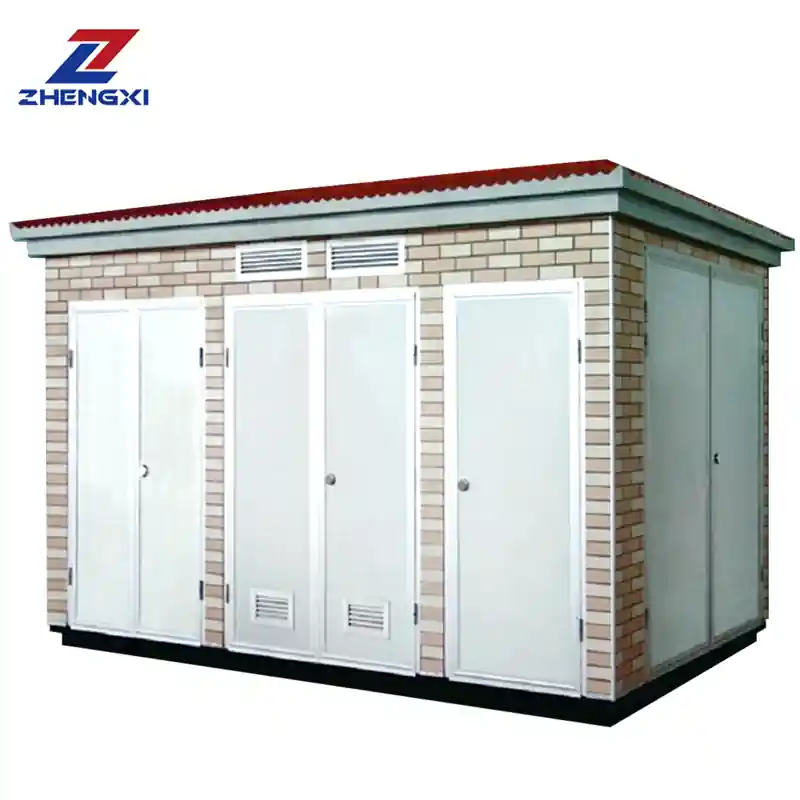
A package substation (also called a packaged, compact or prefabricated substation — sometimes abbreviated CSS) is a factory-assembled, type-tested electrical substation that integrates medium-voltage (MV) switchgear, a distribution transformer and low-voltage (LV) distribution panels within a single enclosed unit. It’s designed for fast deployment and a small footprint where safety, speed of installation and limited civil works are important.
Quick takeaway: package substations reduce site wiring and civil work, speed commissioning, and improve public safety compared with a traditional outdoor yard substation.
Why use a package substation?
- Fast installation — delivered preassembled and pre-tested; minimal onsite wiring.
- Space saving — compact footprint ideal for urban, commercial or constrained sites.
- Safer public installations — enclosed live parts and compartmentalization reduce exposure.
- Predictable cost and schedule — factory builds reduce onsite uncertainty.
- Flexible options — dry or oil transformers, RMU or metal‑enclosed switchgear, remote monitoring packages.
Use cases: residential estates and high-rises, shopping centres, data centres, hospitals, industrial plants, temporary construction sites and renewable-energy collection points.

What’s inside a package substation (components)
A typical packaged unit integrates the following main systems:
- MV switchgear / RMU — incoming protection and sectionalizing for the MV supply.
- Transformer — oil-filled or dry-type (cast-resin) step-down transformer sized to site load (kVA).
- LV distribution panel — breakers, busbars, metering and feeders for site loads.
- Protection & control — protection relays, CTs/PTs, control panels and often SCADA/remote monitoring interfaces.
- Auxiliary systems — earthing, ventilation, lightning protection, cable terminations and drainage.
Design practice: manufacturers separate MV, transformer and LV into dedicated compartments for safety and maintainability.

Common configurations & compartments
Most units follow a three-compartment layout:
- HV/MV compartment — switchgear and incoming terminations.
- Transformer compartment — transformer and associated lifting points/ventilation.
- LV compartment — distribution, metering and cable access.
Enclosure ratings (IP/IK), arc-flash containment and type-testing are important for public installations; confirm local grid-code and municipal requirements before procurement.
How a package substation works — quick overview
- Utility MV feed is terminated at the MV switchgear/RMU.
- MV switchgear protects and switches supply to the transformer.
- The transformer steps down MV to the site LV (e.g., 400/230 V).
- LV switchgear distributes power to site loads and provides protection/isolation.
- Protection relays and metering detect faults and can provide remote alarms and SCADA telemetry.
Advantages and limitations
Advantages
- Reduced site works and commissioning time.
- Smaller footprint; suitable for constrained urban spaces.
- Safer for public or semi-public locations.
- Standardised modules reduce lifecycle costs for many applications.
Limitations & considerations
- Transport and lifting constraints — very large ratings may require specialized handling.
- Heat dissipation in enclosed designs — ventilation and ambient limits are critical.
- Oil-filled transformers require secondary containment and extra fire precautions if installed indoors or near public access.
Selection checklist — what to confirm before you buy
- Voltage & rating: incoming MV level (e.g., 11 kV, 33 kV) and transformer kVA.
- Transformer type: dry-type (indoor, lower maintenance) vs oil-filled (higher kVA, outdoor).
- Switchgear type: RMU, metal-enclosed switchgear or GIS depending on space & safety needs.
- Protection & metering: desired relay types, CT/PT ratios, metering accuracy and SCADA interface.
- Standards & tests: type-test, short-circuit and arc-fault ratings, IP/IK ratings, local grid-code compliance.
- Access & maintainability: door layout, lifting points, spare parts, vendor support and lead time.
- Environmental constraints: ambient temperature, altitude derating and corrosive atmospheres.
Quick decision table
- Need < 1500 kVA, indoor, noise-sensitive site → consider dry-type packaged substation.
- Need > 1500 kVA or outdoor high-rating → consider oil-filled with secondary containment and certified enclosure.
- Limited footprint + urban public site → choose type-tested compact enclosure with arc containment & IP rating.
Typical technical parameters (example)
| Parameter | Typical range / example |
|---|---|
| MV rated voltage | 3.3 kV, 6.6 kV, 11 kV, 33 kV (confirm with utility) |
| Transformer rating | 100 kVA — 5000 kVA (site dependent) |
| LV rated voltage | 400/230 V (standard low-voltage) |
| Short-circuit withstand | Depends on switchgear classification — confirm kA rating |
| Enclosure protection | IP33 — IP55 (depending on indoor/outdoor use) |
| Cooling / ventilation | Natural / forced ventilation; ventilation openings and drainage required |
Note: the table shows typical ranges. Use vendor technical datasheets for exact values for tendering.
Basic maintenance tips (practical)
- Keep ventilation, filters and drainage unobstructed.
- Inspect cable terminations, bushings and gaskets periodically.
- Test protection relays and trip functions according to vendor schedule (annually or per criticality).
- For oil-filled transformers: schedule oil sampling and dielectric tests per OEM recommendations.
- Keep accurate records of tests, inspections and maintenance actions.
Standards & compliance (what to ask vendors)
Ask vendors for evidence of type testing and compliance with applicable standards and local grid code requirements. Typical standards to reference during procurement include transformer and switchgear standards and local distribution codes. Always request the vendor’s factory test reports and third-party inspection documents when procuring for public or safety-critical sites.
FAQs
Q: Is a package substation the same as a compact secondary substation (CSS)?
A: In practice these terms are used interchangeably. They all describe a factory-built assembly that integrates MV switchgear, transformer and LV distribution in a single enclosure.
Q: Can package substations be installed in public areas?
A: Yes — when designed and type-tested to applicable standards and with correct earthing, IP and arc containment ratings, packaged substations are suitable for public or semi-public locations. Follow local regulations and municipal approval processes.
Q: How long does a packaged unit typically last?
A: Service life depends on component choices and maintenance. With correct maintenance, components such as transformers and switchgear can last for decades. Regular inspection and testing extend service life.
Q: Which is better for indoor sites — dry-type or oil-filled transformers?
A: Dry-type transformers are often preferred indoors due to reduced fire risk and simpler containment; oil-filled units are more compact for high kVA but need secondary containment and fire mitigation if used indoors.
Need a specification, datasheet or quote? Request a quote or Download the spec sheet (provide model, required kVA, incoming MV voltage and site constraints) so we can propose the right packaged solution.



 EN
EN  DE
DE  ES
ES  FR
FR  RU
RU  PT
PT  IT
IT  JA
JA  DA
DA  PL
PL  NL
NL  TR
TR