Three-phase transformers are core components in power systems, providing you with a secure and efficient way of voltage transformation. If you want to know how it operates, its application, or how it is used, this guide contains everything you need to know about three-phase transformers.
What is a Three-Phase Transformer?
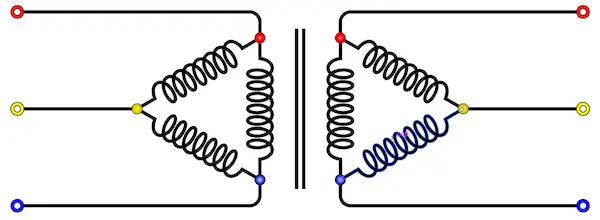
A three-phase transformer is especially designed to utilize in a three-phase power supply system. It is widely utilized for stepping down or stepping up the voltage but not changing the frequency of power. It comprises three primary and three secondary windings, which make it highly effective in balancing the load as well as reducing losses in power compared to single-phase transformers.
Compared to single-phase transformers, which possess only one primary and one secondary winding, a three-phase transformer offers more power and reliability, making them the preferred choice for industrial and large commercial uses.
In an AC power system, three-phase electric power consists of three separate currents that are 120 degrees out of phase with each other. This arrangement provides for continuous power delivery and increased efficiency, as each phase contributes to the constant power supply.
Phase Voltage: The voltage across any one of the phases and the neutral point.
Line Voltage: The voltage between any two phases.
3-phase is more efficient compared to single-phase as it delivers constant power and requires less conductor material to transfer the same quantity of energy.
Faraday’s Law of Induction: The Operating Principle of Transformers
The operation of a transformer is governed by Faraday’s Law of Induction, which states that a varying magnetic field induces an electromotive force (emf) in a nearby conductor. This is the essence of transformer operation and allows the electrical energy to travel from one circuit to another with no direct electrical link.
For a three-phase transformer, the law explains how the primary windings create a magnetic flux that induces voltage on the secondary windings.
Types of Three-Phase Transformers
There are two broad types of three-phase transformers based on construction: Core-Type and Shell-Type.
Core-Type Transformers
These transformers have a core with three limbs that carry the primary and secondary windings.
The windings are divided equally between these limbs, with the lower voltage windings close to the core for insulation purposes.
Core-type transformers are usually used in high-voltage applications and offer better efficiency and reliability.
Shell-Type Transformers
In transformer shells, there are five-limb cores with windings being wound over center limbs.
It is typically smaller in size and can be used for low voltages.
It gives more protection from external environmental conditions and is usually used in more sensitive machinery.
Common Three-Phase Transformer Configurations
Configuration
Symbol
Voltage Transformation
Typical Applications
Key Characteristics
IEC/IEEE Reference
Wye-Delta (Y-Δ)
Yd1
Step-down (HV→LV)
Distribution substations
– 30° phase shift – Neutral available on primary – Handles unbalanced loads
To size a three-phase transformer, you need to consider factors like the voltage and current requirements, as well as the power factor and efficiency.
Conclusion
Choosing the right three-phase transformer depends on your application, voltage requirements, and system configuration. Whether you need a core-type transformer for industrial applications or a delta-delta configuration for load balancing, understanding the technical specifications and capabilities of each transformer type will help ensure that you select the most suitable product.







 EN
EN  DE
DE  ES
ES  FR
FR  RU
RU  PT
PT  IT
IT  JA
JA  DA
DA  PL
PL  NL
NL  TR
TR